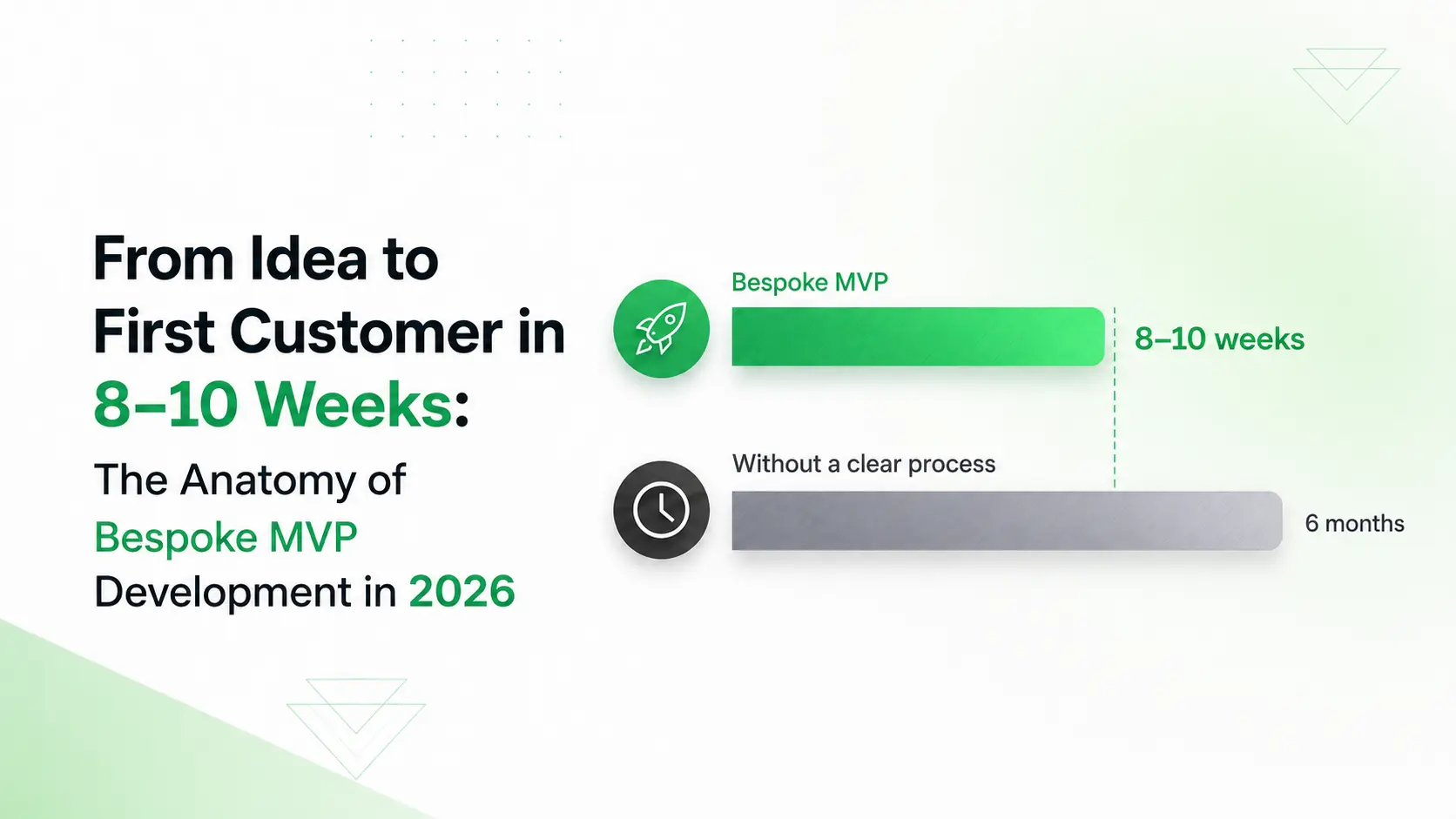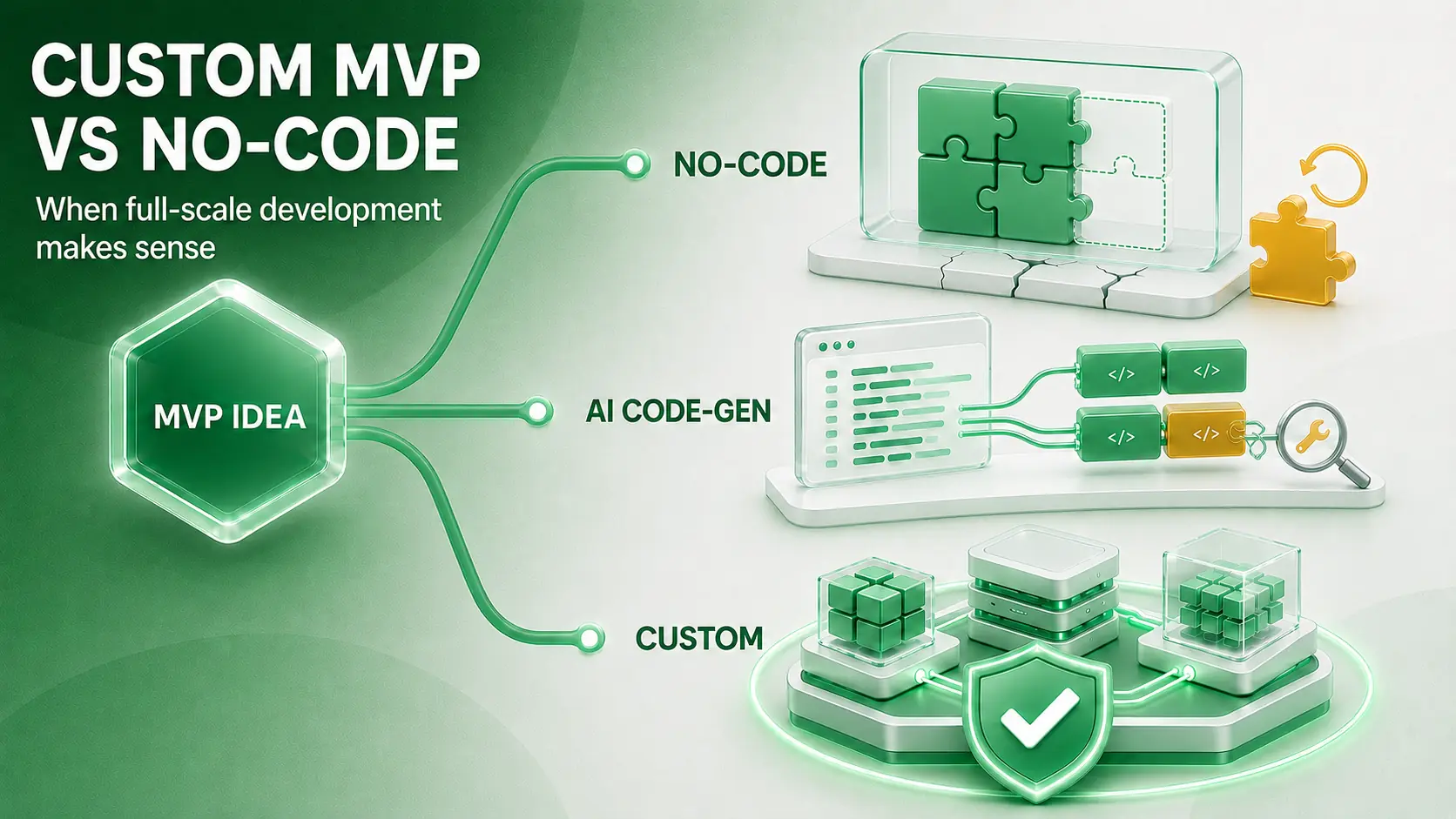
MVP development consulting is a service that helps teams determine which version of a product to build first, before investing in full-scale development. The main value for the client is reducing the risk of building a product that the market won't accept, by validating key hypotheses before a line of code is written. Unlike ordinary development, where a team executes an already-agreed technical brief, consulting defines what that brief should be.
The Wrong Question Almost Every Founder Asks
The call is set for 3:00 PM. The founder joins Zoom, says hello, and within thirty seconds asks the first question: "How much will it cost?" The second question comes even faster: "How quickly can you launch?"
This is a conversation that starts at the wrong end. Not because budget and timelines don't matter - they do. But because both questions assume the main answer is already there: what exactly to build. And most often it isn't - not for anyone on the call. The team may already have perfect Figma mockups, or even a clickable prototype. But a beautiful design is not yet proof of market viability.
The right question sounds different:
"How do we avoid spending a whole quarter and a noticeable chunk of the budget on a product no one needs?"
This question is uncomfortable. There's no simple answer to it in the form of a number and a date. But it's exactly what separates the founder who will be telling a story about traction a year from now from the founder who will be telling a story about a pivot that came too late - when the runway had almost run out, and the team was worn down from reworking what it should have gotten right the first time.
This is where MVP development consulting enters the conversation - though it's rarely named outright on that first call. The founder arrives with a product idea. The consultant arrives with a question: has this idea already been validated by the market? The difference between those two stances is what determines the outcome of the entire project for a startup at any stage.
What MVP Development Consulting Actually Sells (and Why It's Not the Code)
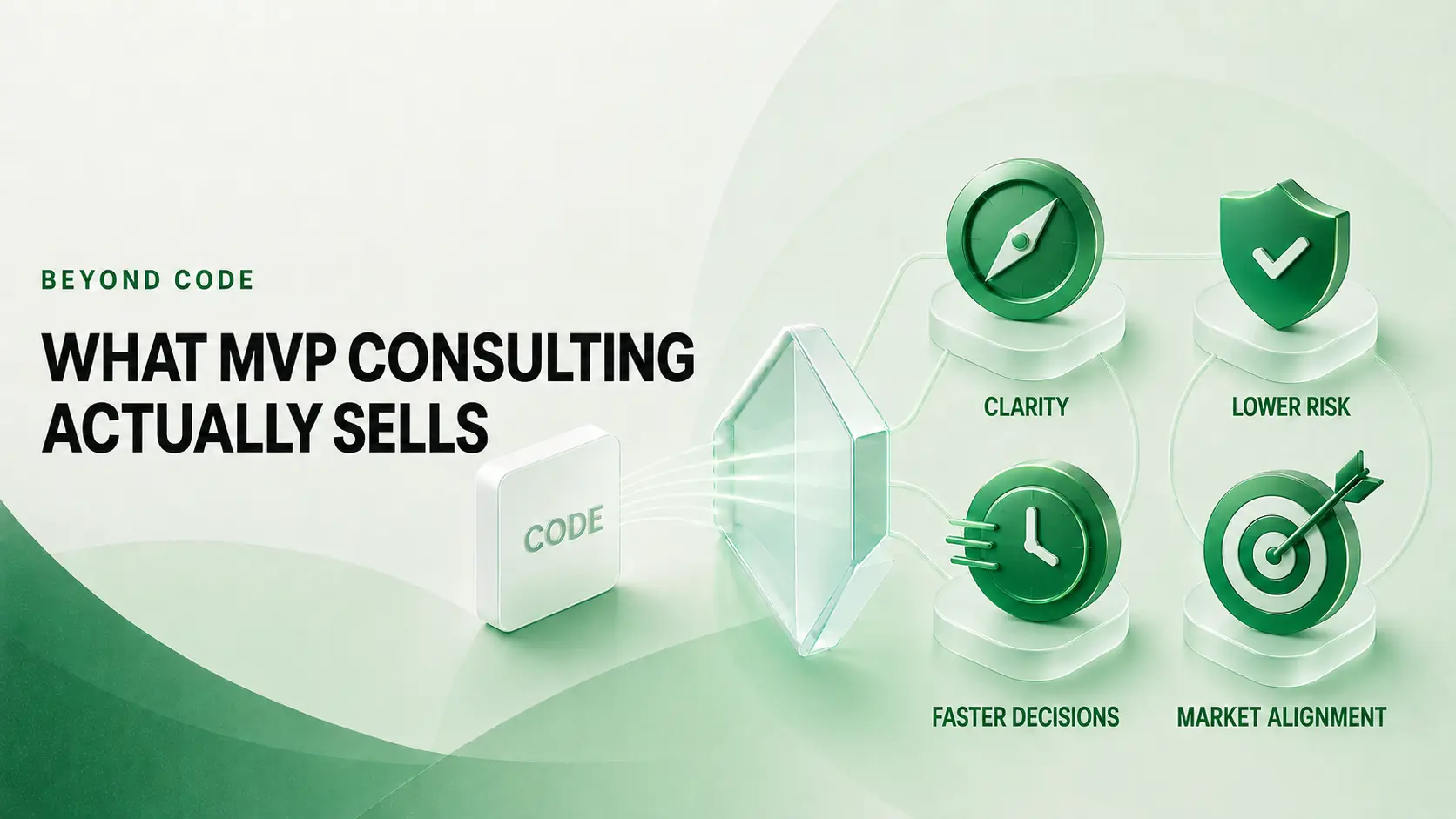
When a client signs a contract with a team that does MVP development consulting, they think they're buying development. In reality, they're buying four things far more valuable than code, and not one of them shows up explicitly on the invoice.
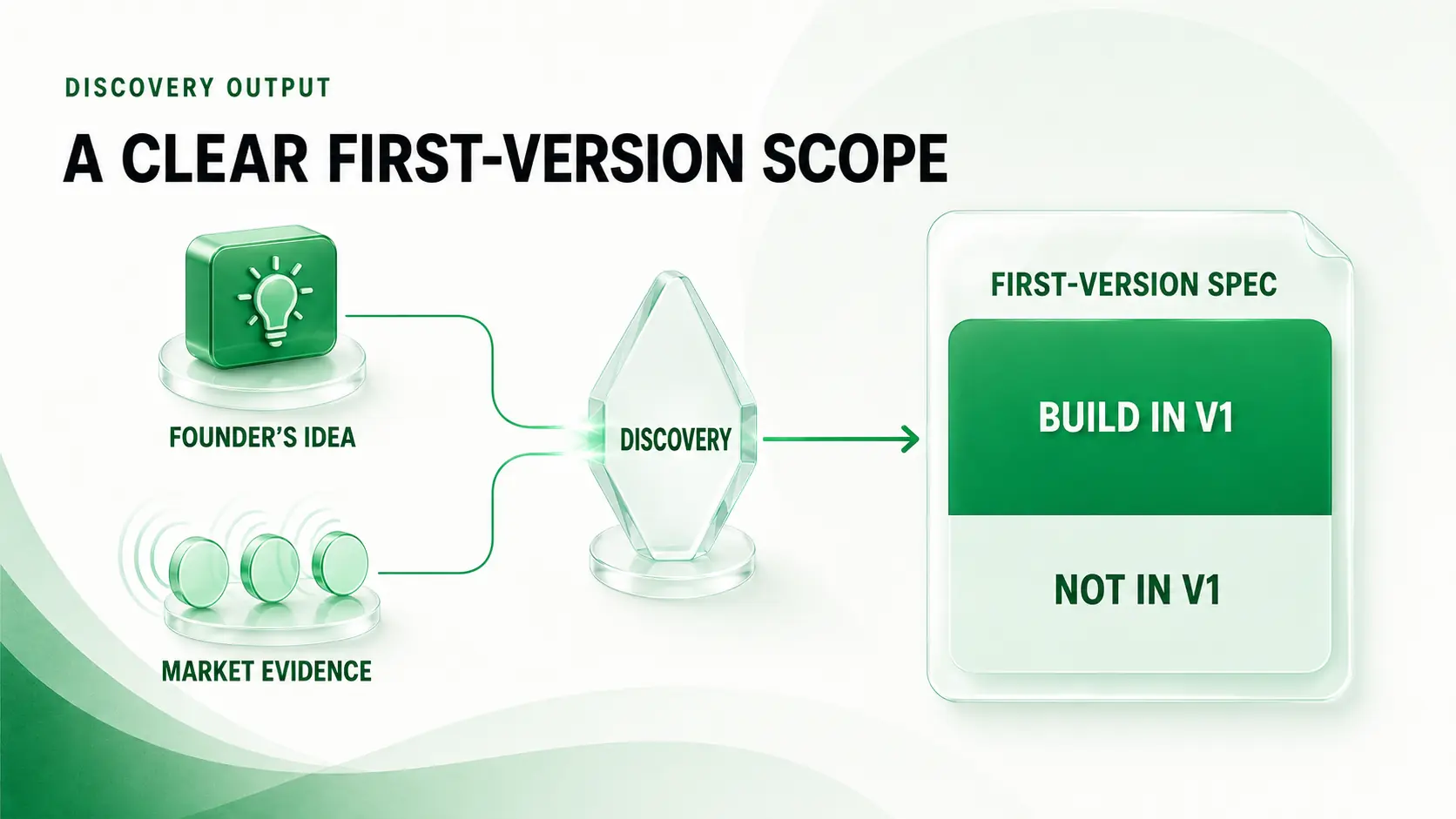
It all starts with clarity. An MVP consultant doesn't just work through a list of tasks - they question the list itself. The discovery phase isn't a formality before the sprints kick off; it's the process that separates "I want" from "the market needs." The result of good discovery is a concrete specification that defines not only what to build, but what NOT to build in the first version. It saves weeks of development, because the team builds the right thing on the first try, not the third.
This clarity is what sets MVP consulting services apart from ordinary contract coding, where the client brings a finished feature list, and the team simply counts the hours to implement it, without ever asking "but why." It's not just a document - it's an insight into what the market is actually ready to buy, rather than what the team wants to build.
With that clarity comes the most important thing of all - a radical reduction in risk. The most expensive mistake in a product isn't the one you made, but the one you found months into development, when it's already too late to change anything without rewriting half the codebase. The consultant sees these risks before the start, while they still cost an hour of conversation; the developer sees them only after the invoice is issued and the deadline has passed. The cost of upfront validation versus the tens of percent of the budget burned on rewriting the architecture half a year later - that is the real cost of the mistake and the real ROI of consulting. The kind you can't show in a typical portfolio: there you only see finished products, not the money a team didn't spend thanks to a single conversation. Every assumption no one checked costs more than it seems - and it's not only about money, but about the velocity of a team that drops every time something has to be rebuilt.
Once the risks are surfaced, the speed of decision-making changes dramatically. Without a consultant, every decision about a feature turns into a discussion between the founder, the designer, and the developer, where the loudest voice belongs to whoever spoke last, not to whoever has the best data. With a consultant, there's a framework: how to prioritize the backlog, how to keep focus on what matters, and how to react to a shifting market without a panicked pivot every week. Time is the one resource a startup can't buy more of, no matter how much runway is left in the account. Every week of discussion without a framework is a week no one gets back.
And finally, the strategic alignment of the product with the market, rather than with the founder's idea of the perfect product. Founders fall in love with their own idea - and that's simultaneously their strength and their greatest weakness: without that obsession, the product would never have appeared, yet that same obsession makes it hard to see that the market wants something slightly different. A good MVP product development consultant is someone who roots for your success, not for your idea, and behaves like a partner rather than a contractor waiting for the next invoice. An outside, unbiased perspective is a competitive advantage and real value you can't buy with money paid to your own team, because your own team looks at the product through the same eyes as the founder.
Three Moments When Clients Finally Get It
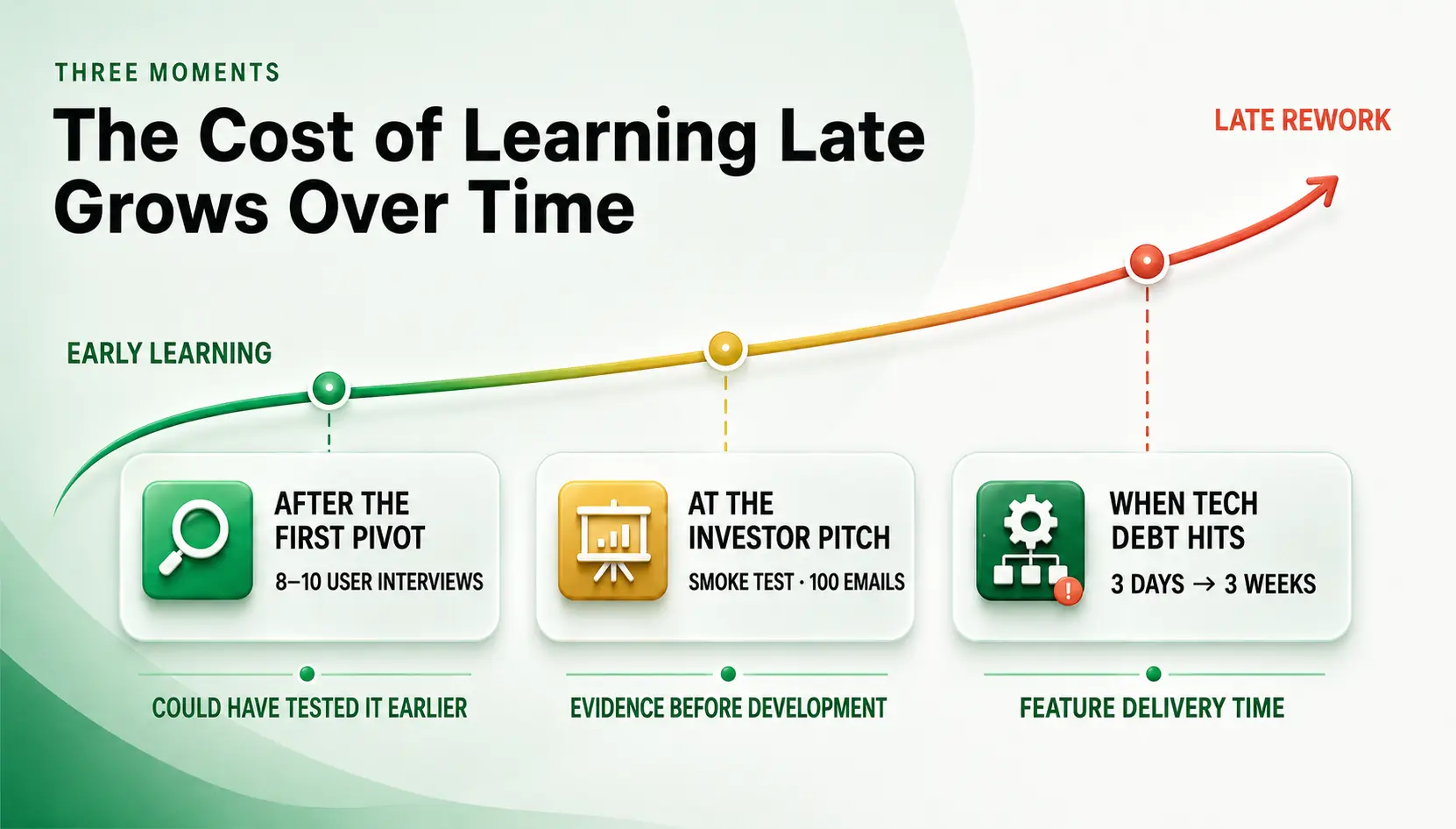
Moment One: After the First Pivot
The team built the MVP on schedule. They showed it to their first users. The numbers looked decent, except for one detail: no one was touching the core feature the entire product was built around. People came in, looked around, even praised the design - and left without doing the one thing the product existed for. The founder gathered the team and said the phrase heard hundreds of times across hundreds of startups: "We need to change direction." Months of work - into the trash, along with a piece of runway that's never coming back. In extreme cases, it's half a year, but even a few weeks, multiplied by the team's salaries, is a sum you don't want to lose on a guess.
What the consultant could have done: run 8-10 customer development interviews with potential users before the sprints started - with a concrete question about this specific feature, not about the product in general. The team is too close to its own product to see it without bias, so these conversations are led by someone from the outside. The result: either a confirmed hypothesis with real user feedback you wouldn't be ashamed to show an investor, or a canceled feature that would have cost nothing but two weeks of discovery. It's the same learning the team got after the pivot, only ten times cheaper.
Moment Two: Before the Pitch Deck for Investors
The product exists. There are metrics, though not very convincing ones. But the investor on the call asks one simple question: "How did you validate this hypothesis before you started building?" The silence stretches a few seconds longer than is comfortable for anyone in the room. There was no validation - there was only development, which immediately went toward features rather than toward checking demand. The founder knows there's no answer before the question has even fully landed.
What the MVP product development consultant could have done: build a validation framework from day one - for example, launch a smoke test through a landing page and collect the first 100 emails of interested users before development even starts. Then slide number three in the pitch deck holds not guesses but data with real accuracy: how many people were surveyed, what percentage confirmed the problem. It's the difference between "we believe the market needs this" and "we checked, and here's the proof."
Moment Three: When Technical Debt Paralyzes Growth
The MVP launched and even became popular - traction showed up faster than the team expected. The momentum is there, but the infrastructure can't hold it. You'd think it's time to celebrate. But adding a new feature now takes three weeks instead of three days, and the development team quietly hates every new request from the product manager. The reason is simple: the architecture was assembled to launch the product fast, not to scale it over the next two years. Every new integration now breaks something in three other places in the codebase, and no one on the team even remembers anymore why a particular module is written the way it is.
What the consultant could have done: at the planning stage, determine which modules can be written as a monolith for speed and where a microservice architecture is needed right away - and lay down the stack so that the most expensive-to-change decisions are right from the very start. This avoids the trap where every new integration breaks the system. Teams rarely regret the two extra weeks at the start - more often, they regret three months of refactoring a year later.
How to Tell a Consultant from a Vendor: Five Signals You'll See in the First Week
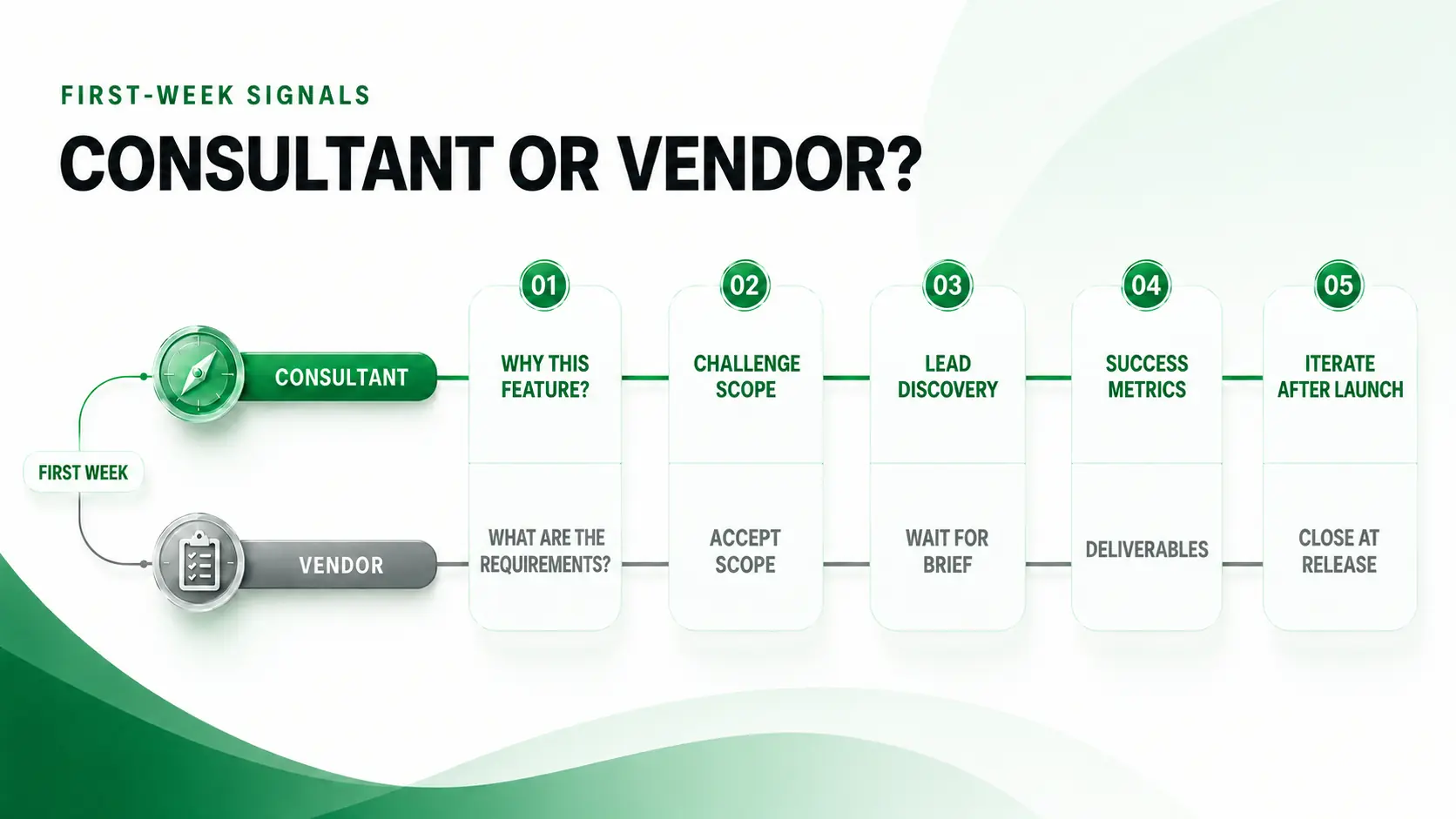
The difference between a consultant and a vendor can't be seen in a portfolio, or even in the expertise both demonstrate equally convincingly on their websites - it shows in how the first week of work goes.
The consultant asks: "Why this feature?" The vendor asks: "What are the requirements for this feature?" The first question sometimes cancels the feature entirely, before a single hour has been spent on it. The second always leads to an estimate and a timeline, regardless of whether the feature is needed by the product at all.
The consultant pushes back on the scope when they see it's been inflated "just in case." The vendor agrees with almost everything the client asks for - agreeing is simpler and safer for the relationship than arguing with the person who pays the bills. That pushback is unpleasant in the moment and useful in the outcome: it's exactly what saves the budget that would otherwise have gone toward features no one will use after launch.
The consultant has their own process for discovery, which they offer the client in the very first week. The vendor waits for the client to bring a finished brief and starts counting hours the moment they receive the document. The consultant, on the contrary, helps write that document - and this is where you can clearly see why "A skilled MVP development consultant doesn't wait for the brief - they help write it" isn't just a nice line from a deck, but a real difference in approach across the first two weeks of collaboration.
The consultant talks about success metrics before development even begins: what adoption is expected in the first thirty days, what retention would be considered good, what business impact would justify the founder's investment. The vendor, by contrast, talks about deliverables: how many screens, how many API endpoints, when the deployment happens, and when the ticket can be closed in Jira.
And finally, the consultant doesn't vanish on the release date. The first real adoption and retention metrics appear only after launch - and they're exactly what shows which of the initial hypotheses the market confirmed and which it didn't. An outcome-oriented consultant stays close at this stage so the team can adjust the priorities of the next iteration while the data is still fresh. The vendor, by contrast, closes the project on the release date and moves on to the next client, never even finding out whether anyone uses the product at all.
In practice, this looks like a sequence that underlies how we work with every client:
Discovery → Validation → Build → Iterate.
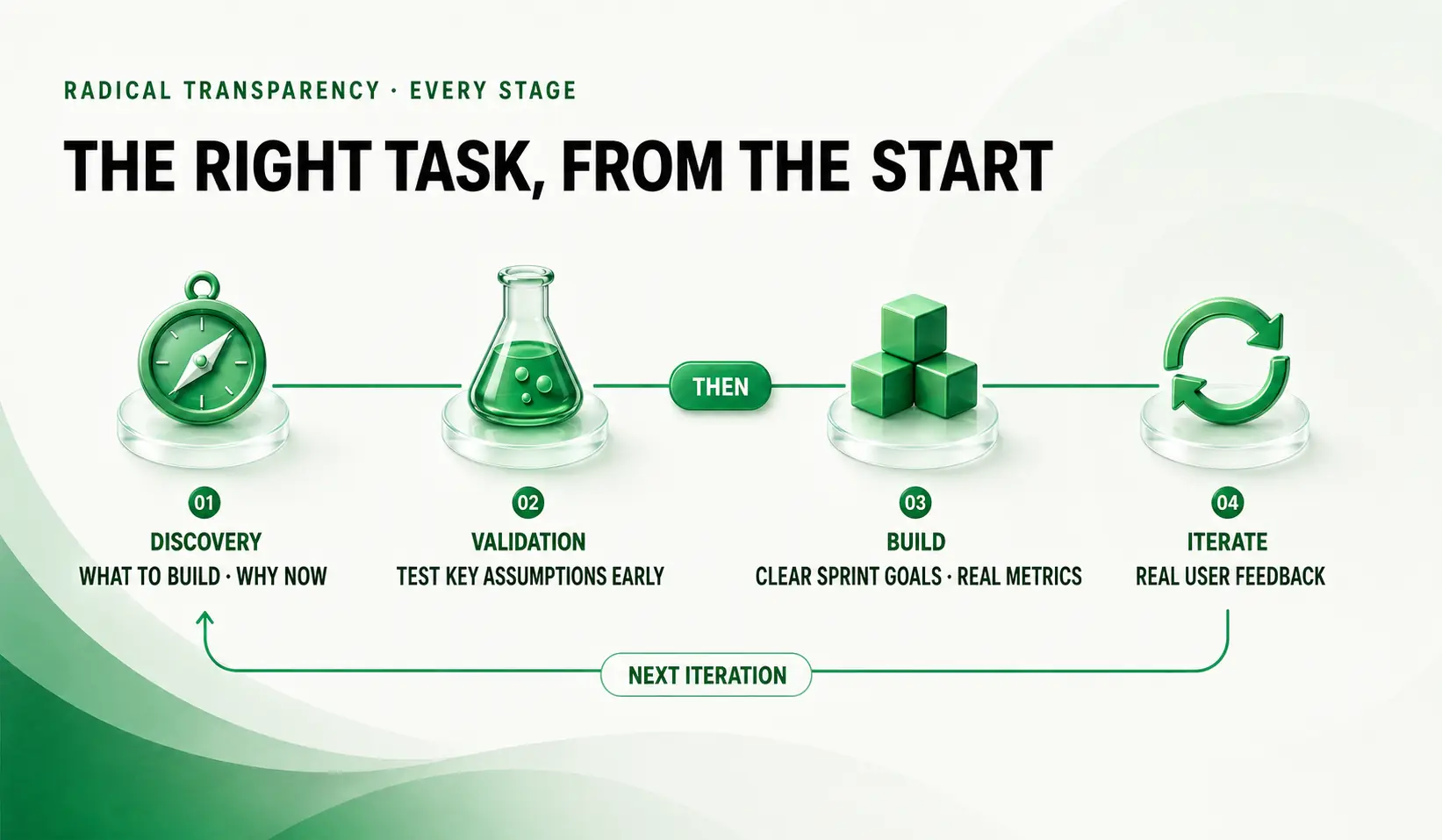
This isn't an invention of consulting - Lean Startup described this logic ten years ago. Most teams ignore this logic anyway, because no one is standing next to them forcing them to follow it when the deadline is pressing, and they want to write code faster. That's exactly where the consultant's value lies: not letting the team cut corners where it would cost the most.
First - understanding what to build and why, and why right now. Then - checking the key assumptions where a mistake is still cheap, not where it's already become a line in the budget. Only after that - development, with clear sprint goals and a roadmap tied to real metrics and clear prioritization, rather than to the product manager's guesses. And finally - iteration based on feedback from real users, not from internal discussions within a team already too in love with its own solution. Radical transparency at each of these stages costs less than its absence, even if, in the moment, it's less pleasant for everyone involved.
That's how an MVP product development consultant works - one who sees their role not as "execute the task," but as "make sure the task was the right one from the very start" - and is ready to say it to the client out loud, even if the client won't like the answer.
The Cost of Figuring This Out Too Late
Let's go back to that 3:00 PM call. The question "how much and how fast" never goes away - budget and timelines will always be real constraints for any startup, regardless of how much investment it has. But these are no longer the only questions worth asking, if you've ever seen a startup spend a quarter and a significant part of its budget on a product the market simply ignored.
MVP product development consulting isn't an extra expense on top of an already-limited budget. It's insurance against the single decision that costs a startup the most: building the wrong product, for the wrong market, at the wrong moment. The consultant exists precisely so that you don't have to fix that decision after the fact, losing not only time but the team's confidence, which is far harder to restore than to rewrite code.
The most expensive failure in a startup isn't the one you see right away. It's the one the team notices months into development, when too much has already been invested to simply turn around, and there's too little traction to justify staying the course. It's not just budget but an investment that pays off best exactly when the team can still turn around without losses. This is the point at which most founders first seriously think about consulting - later than would have been cheaper, and already with a smaller budget for fixing things than they had at the start.
If any of this sounded familiar, it might be worth a conversation before the next sprint begins.