An MVP app development company is a software development partner that helps startups and product teams design, build, and launch a minimum viable product - a first working version of a digital product built to validate a core hypothesis with real users before significant resources are committed to full-scale development. In 2026, the market for MVP app development services spans independent freelancers, classic agencies, specialized MVP studios, product companies, and AI-accelerated teams - each with a distinct risk profile, cost structure, and working model.
Choosing between them is one of the highest-leverage decisions a startup makes in its first year: the right partner gets a product to market in weeks, with architecture that survives growth; the wrong one produces something that technically works but can’t be changed without a full rewrite.
That's not bad luck. That's a predictable outcome of a flawed selection process.
Choosing an MVP app development company is not the same as hiring a contractor to build a feature list. It's a decision that shapes time to market, the cost of every future change, and whether the product can survive its first real users without falling apart. This guide is written for founders who understand that distinction - and want a framework for making the right call the first time.
What follows covers how development models differ in 2026, which signals reveal risk before a contract is signed, how AI acceleration changes the equation, and what the first four weeks of a real engagement should look like.
1. The Market in 2026: Five Models, Five Different Risk Profiles
Search for "MVP app development services" and the results are overwhelming - agencies, studios, freelancers, product companies, AI-native teams offering custom software development, web and mobile app development, and end-to-end product development services. They all use the same language: fast, scalable, startup-friendly. The working models underneath that language are entirely different.
Independent Developers (Freelance)
The lowest entry cost on the market, typically $4k–$15k for an MVP scope. The tradeoff is that the founder absorbs everything a management layer normally handles: coordination, quality control, deadline accountability, continuity risk. If the developer disappears or burns out, the project stops. This model makes sense only when the startup has a technical co-founder who can function as a CTO - reviewing code, managing sprints, making architecture calls. Without that, it's the fastest route to technical debt that looks like savings.
Classic Service Agencies
Full-structure teams - project management, design, development, QA - with established processes and clear reporting. They deliver predictability, which is genuinely valuable. The problem for startups is that these agencies were built for corporate clients with stable requirements and long timelines. Their quality standards and approval cycles are calibrated for that world, not for a seed-stage team that needs to pivot based on user feedback every three weeks. Eastern European agencies in this category run $30k–$75k for MVP app development services; US and UK firms offering equivalent services start around $75k and regularly exceed $150k for the same scope.
Specialized MVP Studios
Teams whose entire workflow is designed around startups and SaaS product development - whether that means web applications, mobile MVP app development services, or cross-platform SaaS solutions. The discovery phase is treated as a real discipline - user research, business logic mapping, feature prioritization - not a formality before coding starts. UI/UX design is integrated into product logic rather than applied as a visual layer afterward - which means the design process runs in parallel with development, not after it. Architecture is built for iteration from the first sprint, not retrofitted after funding. These studios typically charge $50k–$150k, and that range reflects genuine depth: they provide a foundation built for iteration, not just a feature list shipped on schedule. For founders preparing for a seed round or planning to scale, this is usually the right model.
Product Companies (Service-to-Product)
Companies that run their own digital systems and take on MVP app development work in parallel. The advantage is real: these teams have built products that handle production loads, and they understand how technical decisions affect business metrics because they live with those consequences themselves. The risk is prioritization - when their own product roadmap heats up, client development projects can stall. This model suits complex, niche solutions that require genuine engineering depth and where a client relationship with a technical peer matters.
AI-Accelerated Teams
In 2026, every serious development team uses AI tooling. The category worth naming separately is teams that have restructured their entire workflow around it - using Cursor, Copilot, and custom automation not just to write boilerplate but to compress full development cycles. For founders looking for mobile MVP app development services or rapid web product delivery on a constrained budget, this model deserves serious consideration. Budgets run $15k–$80k, timelines 4–12 weeks. The effectiveness is real and the risks are real in equal measure. More on this shortly.
| Type | Budget | Timeline | Best For | Primary Risk |
|---|---|---|---|---|
| Freelancer | $4k–$15k | 2–6 wks | Simple solutions with a technical co-founder | No process, single point of failure |
| Agency (EE) | $30k–$75k | 8–16 wks | Mid-complexity MVP on a limited budget | Inconsistent quality, weak product accountability |
| MVP Studio | $50k–$150k | 10–19 wks | Seed stage, scaling, investor readiness | High cost for early hypothesis validation |
| Product Co. | $50k–$150k | 10–20 wks | Complex niche solutions, deep engineering | Your project may be secondary to their own |
| Agency (US/UK) | $75k–$220k+ | 3–6 mo | Regulated industries (FinTech, MedTech) | Excessive process and budget for MVP stage |
| AI Team | $15k–$80k | 4–12 wks | Rapid hypothesis validation, limited budget | Weak architecture without senior oversight |
The right question when evaluating these models isn't which one is best in the abstract. It's which development model matches the current stage of the product and the level of uncertainty the team is working with. Pre-seed founders validating hypotheses need speed and flexibility. Seed-stage founders preparing to scale need stability and architecture. Those are different problems, and they call for different solutions.
2. AI Acceleration: What It Actually Changes (and What It Doesn't)
It's worth being direct about something the industry tends to either oversell or dismiss. AI tooling has genuinely changed what's possible in MVP app development. Automation of routine logic, standard integrations, repetitive components - these tasks move faster now, and that speed translates into real advantages: lower costs on standard functionality, faster time to market, more budget available for the things that actually differentiate a product.
What AI hasn't changed is the nature of good engineering judgment. There's a meaningful difference between a team that uses AI as an acceleration layer under the control of a senior engineer in an MVP development context, and a team where AI has replaced architectural thinking entirely. The first model delivers a better product faster. The second delivers an MVP faster and then collapses under its own technical debt.
Three risks that startups consistently underestimate in AI-accelerated development:
Security Vulnerabilities
AI tools suggest patterns that work - but not always patterns that are secure. In MVP development, authentication flows, personal data storage, and payment processing are zones where generated code can contain vulnerabilities that pass basic testing and surface only after launch. Without a dedicated security review process built into the MVP app development workflow, the code looks fine right up until it isn't.
Dependency Conflicts
Auto-generated code often pulls in more third-party libraries than a human architect would choose. Each library is a dependency, and dependencies interact. Updating one breaks another, which breaks a third. Six months into support, this chain reaction becomes a significant maintenance problem - one that was invisible during development.
False Confidence
This is the most dangerous failure mode in custom MVP development. The code looks logical, passes testing, and demos beautifully. It simply wasn't written to handle edge cases that real users generate constantly. The first production release exposes this. An experienced MVP app development company with real engineering oversight knows to look for these gaps; a team running on automation alone doesn't.
When evaluating any team that leads with AI as a value proposition, the right question is specific: "Who is architecturally responsible for this codebase, and what does the code review process look like?" A concrete answer is a good sign. "The AI handles it" is not.
3. What to Actually Evaluate (It's Not the Portfolio)
Portfolio review is the default evaluation method for most founders choosing MVP app development services, and it's the least useful one. A portfolio shows design quality and marketing presentation. It doesn't show who wrote the code, how the architecture evolved, how the team handled a missed deadline, or whether the product is still running eighteen months after launch.
The evaluation that actually predicts outcomes runs across three dimensions.
Technical Dimension
The questions worth asking of any MVP app design and development services provider aren't about which technologies a team prefers. They're about how a team reasons about technology choices. Why this backend stack for this specific product, rather than a standard recommendation? How is the CI/CD pipeline structured? What does the testing strategy look like across unit, integration, and end-to-end? Does the team think about scalable architecture from sprint one, or is it deferred to "after the MVP"? The second answer almost always means expensive rework after launch.
UI/UX integration matters here too. Ask whether a design system gets established early, and whether UI/UX decisions happen alongside product logic or are applied afterward as a visual layer over already-built functionality. Good UI/UX design is architecture, not decoration. The difference shows up in every future iteration.
Process Dimension
The baseline for any serious MVP app development company in 2026: demos every one to two weeks, transparent reporting, a single named project manager as the point of contact. Without regular demos, founders lose visibility into what's happening until it's expensive to change. Without a named PM, accountability diffuses across the team.
Pay attention to how a team talks about risk. A mature team surfaces problems early and comes to that conversation with options. The phrase "everything is on track" without specifics is a warning sign - it usually means problems are being managed quietly until they can't be.
Agile and lean approaches both have merit, but what matters in practice is cadence and transparency, not methodology labels. Across MVP app development services, the approach to sprint planning, task visibility, and risk escalation reveals far more about a team than any certification or process framework. Ask to see the task management system. Ask how sprint planning works. Ask what happens when a technical problem blocks progress mid-sprint.
Business Dimension
Three questions that need specific answers before any contract is signed:
- Ownership: who holds rights to the code, design files, and documentation. "You own everything" is not a legal answer. It needs to be a specific clause in the contract, and it needs to cover third-party libraries and their commercial use restrictions.
- Confidentiality: the NDA needs to extend to subcontractors and freelancers the company might bring in. At early stages, founders often share business models and internal analytics before work starts. That information needs protection across the full team.
- Termination: what happens if priorities shift or the relationship isn't working. The code handover procedure - format, timeline, access credentials - should be defined before work begins, not negotiated during a conflict.
4. Red Flags That Experienced Founders Recognize Early
The MVP app development companies that cause the most damage rarely look risky at first. They often have polished presentations, responsive sales processes, and reasonable-looking portfolios. The problems surface after the contract is signed and the first portion of the budget is spent. These signals, visible in the first conversations, predict those problems.
"We can deliver your MVP in four weeks"
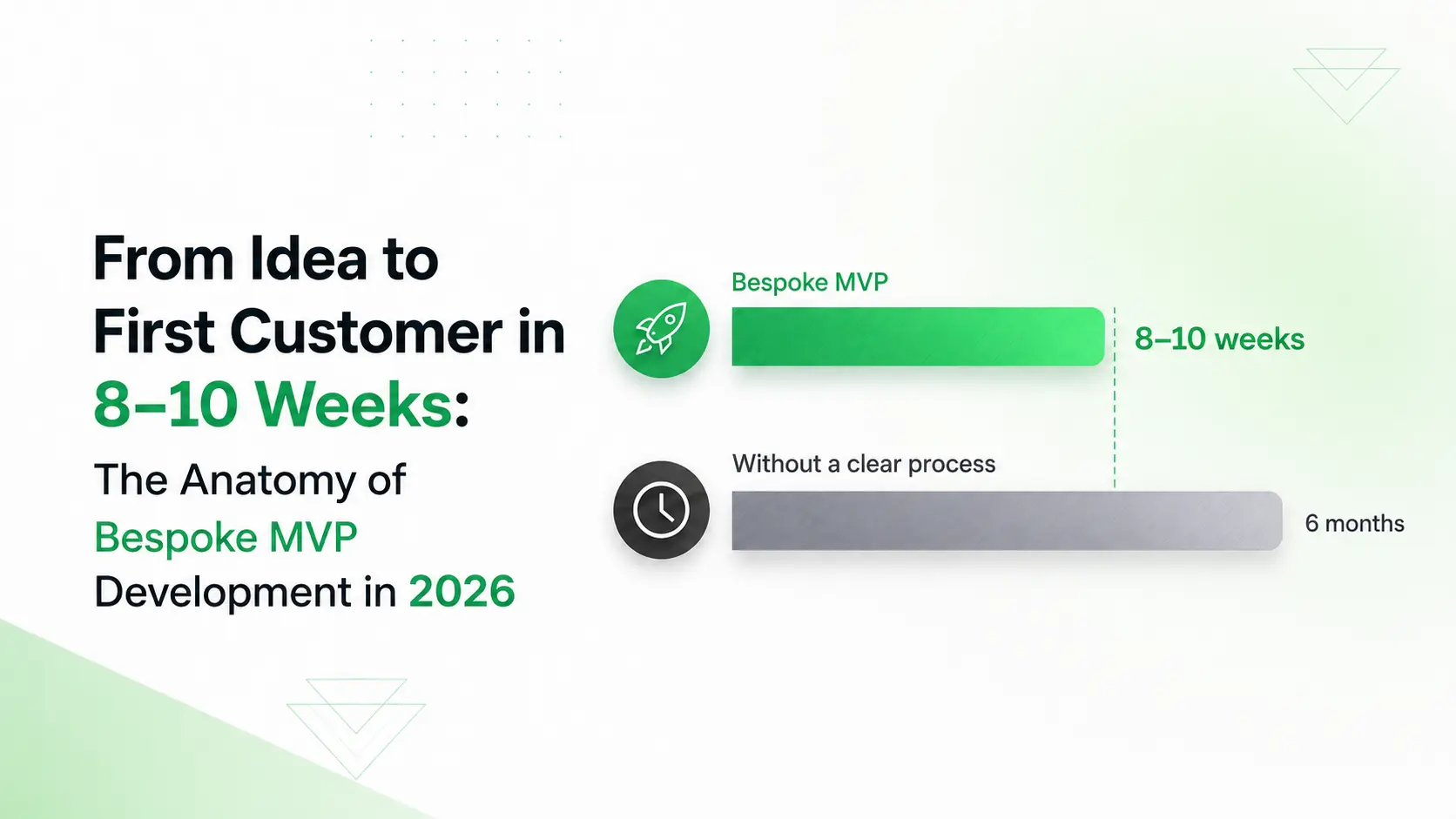
Custom MVP app development - real discovery, architecture, design, development, and QA - takes eight to nineteen weeks. A four-week promise means either a template-based prototype that won't survive real users, or a team that hasn't understood the scope. If timelines are quoted before a discovery phase has happened, ask what the estimate is based on.
No Discovery Phase
Discovery is where a team learns the business, the users, and the actual problem before writing code. Teams that skip this step build their interpretation of the idea - not a product the market needs. Reworking a finished product always costs more than planning it properly. This is the single most expensive shortcut in MVP app development services.
Case Studies Without Live Products
A polished PDF case study is not evidence of quality, and a company’s reputation in MVP app development services is only as strong as the live products it can point to. Ask for a link to a working product. Offer to speak with a past client directly. If every request is met with "NDA prevents us from sharing," treat that as a reason for skepticism, not automatic disqualification - but ask follow-up questions.
Anonymous Management
"We have an experienced team" is not an answer. Ask specifically: who will be the named PM, what is their background, and how many active projects are they running in parallel? A PM managing eight projects simultaneously will give any one product a fraction of the attention it needs. Ask about their direct experience with products at a similar stage - early-stage SaaS, mobile apps, platform builds - not just years in the industry.
The Conversation Starts and Stays on Budget
If the first call with an MVP app development company is primarily about budget and deadline, the team is thinking like a vendor. A real development partner asks about the business model first, then the user audience, then the MVP hypothesis being tested. Features and cost come after that.
Vague Answers on Intellectual Property
Reliable MVP mobile app development companies have clear legal protocols on IP. Evasiveness here - "that's not really how we work" or "don't worry, it's all yours" without documentation - is a signal to stop the conversation or escalate to legal review before signing.
"AI Means We're Twice as Fast"
Speed claims without a specific description of the quality control and architecture review process are marketing, not a value proposition. AI does accelerate development - but "twice as fast" without a senior engineer responsible for the codebase means the speed is being borrowed against future technical debt.
5. Questions That Reveal How a Team Actually Thinks
The first call with a potential MVP app development company is a diagnostic, not a presentation. The goal is to understand how the team approaches MVP scoping, risk management, and the hard tradeoffs every MVP mobile app development company faces in the first sprint. The goal is to understand how the team reasons under uncertainty and handles situations that don't go according to plan. These questions cut through the sales layer.
"Tell us about a project that didn't go as planned."
Every experienced team has a real answer to this. A specific story - what broke, how the team responded, what changed afterward - is a good sign. "That hasn't happened to us" is a sign of inexperience or a culture that doesn't acknowledge failure openly. Both are problems.
"What does your discovery process look like before development starts?"
A serious answer includes stages: user research, business logic analysis, technical specification, feature prioritization. "We move straight to development to save time" means the team will build their interpretation of the product, not the product the market needs.
"How often will we see a working product during development?"
The right answer: demos at the end of every sprint, access to the test environment available around the clock. "We'll show results at the end of the phase" means no visibility into budget consumption until it's too late to course-correct.
"How do you use AI tools, and who owns code quality?"
A good answer names specific tools - Cursor, Copilot, others - and describes the senior engineer review process. "AI does everything automatically" without architectural oversight is the risk profile described in section two. "We don't use AI at all" means the team is either behind the industry or not being honest.
"What happens when priorities change mid-development?"
Changes should be assessed for impact on scope, budget, and timeline, then documented before work begins. "No problem, we'll handle it" sounds reassuring; in practice, unstructured scope changes are the primary driver of technical debt and budget overruns in MVP development.
"Why are you recommending this technical stack?"
The answer should be specific to the product: development speed for this use case, support cost, developer availability in the market, scalability profile for the expected load. "We always use this" or "everyone uses it" means the recommendation is about the team's comfort, not the client's product.
"What does support look like after launch?"
Launch is the beginning of a new cost structure, not the end of the project. A serious MVP app design and development services provider describes support models and handover procedures before the contract is signed. "We'll figure it out after release" is a business continuity risk.
Pay equal attention to the questions the team asks in return. If they don't ask about the business model, the user audience, and the core hypothesis being tested, the product they build will reflect their assumptions - not the founder's vision.
6. The Hidden Cost Structure Nobody Mentions at the Start
Development cost is the number that appears in proposals. The real budget forms after launch. Most contractors stay quiet about this at the start because raising it complicates the sale. Founders who understand it in advance make better decisions about architecture, infrastructure, and contractor selection.
Technical Support and Stability
Code is not static. Security updates, OS compatibility, bugs that only appear under real user load - these are not extras. They're the cost of keeping a product operational. The architecture decisions made during MVP development directly determine how expensive this maintenance becomes. A codebase built for iteration is fundamentally cheaper to support than one built for a demo.
Cloud Infrastructure and Scaling
Server costs at launch can look trivial. They grow with the user base, often non-linearly. The architecture choices made during MVP development determine whether scaling costs stay manageable or spike unpredictably. Ask about the cloud infrastructure plan, deployment pipeline, and what the cost model looks like at 10x current user volume. Performance under real load is a function of architecture decisions made before launch, not after.
Third-Party Service Ecosystem
Modern web and mobile app development runs on integrations: payments, analytics, authentication, mapping, communication APIs. Whether the product is a web platform, a native app, or delivered through mobile MVP app development services, these dependencies compound quickly. Most services offer generous free tiers that disappear quickly as user volume grows. The cost of these integrations at scale is a real budget line that experienced founders model before launch, not after.
Post-Launch Iteration
The first real user feedback always contains surprises. Changing user flows, reprioritizing features, responding to unexpected behavior patterns - this isn't fixing mistakes. It's normal product adaptation. An MVP mobile app development company that understands this helps founders manage iteration costs; one that treats every change as out-of-scope contributes to the problem.
A results-oriented team surfaces these cost areas in the first conversation - not because it makes the sale easier, but because their goal is a product that operates reliably in a real environment. When the conversation stays entirely on the development budget, that's a signal about where the team's accountability ends.
7. Time Is the Cost Nobody Puts in the Spreadsheet
Consider two scenarios for MVP app development. Contractor A costs $12,000 more, but has a prepared team, a structured discovery process, and delivers the first working demo two weeks after kickoff. Contractor B offered a lower number for the same development scope - but the negotiation drags, scope clarification takes weeks, and working code won't appear for two months after signing.
On paper, Contractor B saved money on MVP development services. In practice, the founder lost two months of market advantage, spent those months on operational costs, and missed the window to collect user feedback before a competitor did.
For startups, time has a cost that doesn't appear in development proposals. Every additional month of delay means runway consumed without validation, competitor momentum building, and market conditions shifting independently of the product schedule. The critical question isn't "what's cheaper" - it's "what gets to validation fastest with acceptable quality."
This is where AI-accelerated teams can deliver genuine value. Moving fast under architectural control - senior engineer oversight, regular code review, a clear understanding of how the product evolves after launch - is legitimately faster. Moving fast without that control produces an MVP in five weeks and a rewrite six months later.
The time wasn't saved; it was borrowed at a high interest rate.
The right framing isn't speed versus quality. It's choosing an MVP app development company capable of delivering predictable progress toward launch without the hidden compromises that surface in the first months of production.
8. Contract Review: What to Lock Down Before Work Starts
Most problems in custom MVP app development don't originate in technical mistakes. They originate in conditions that weren't clearly defined before work began. These are the items that need specific, written answers - not verbal reassurances.
IP and Code Ownership
The contract should state explicitly that all rights - code, design files, documentation - transfer to the client upon payment. Verify which third-party libraries are used and whether any carry commercial use restrictions - this matters especially for mobile app development, where platform store policies add another layer of compliance. "You own everything" as a verbal statement is not legally meaningful.
NDA and Confidentiality Scope
The NDA should cover not just the core team but any subcontractors or freelancers brought in during the project. Founders routinely share business models, analytics, and user data before work begins. That information needs protection across the full engagement.
Early Termination and Handover
Even well-intentioned projects change teams - budget shifts, pace issues, strategic pivots. The handover procedure needs to be defined in the contract: what gets transferred, in what format, within what timeline, and who holds access credentials at each stage.
Support After Launch
Define what support period is included in the project cost, which issues are fixed without additional charge, and what the ongoing support model looks like after that period ends. Launch is the beginning of the product lifecycle, not the end of the engagement.
Scope Change Process
Every MVP evolves during development. New information from user research, changed priorities, better ideas - these produce change requests. The contract should specify how changes are evaluated, documented, and priced before implementation begins. Unstructured scope changes are the primary driver of budget overruns and technical debt.
9. The First Four Weeks: Validating the Choice After Signing
Most guides on choosing an MVP mobile app development company end at the contract stage. The contract documents the agreement. Whether the right MVP app development company was chosen becomes clear in the first weeks of actual work - before significant budget has been spent and while course correction is still affordable.
The first four weeks of MVP development reveal the real working model. No accumulated technical debt yet, no inertia in the process, no established patterns to hide behind. What appears in this window is how the team actually operates - and whether the MVP app development company lives up to what it promised in the sales process.
Regular Demos
Working results should be visible on a consistent schedule. At this stage, that might be a prototype of a specific scenario, a working component, or a completed module - not necessarily finished functionality. What matters is the rhythm. If two weeks pass without a visible result, the founder has lost visibility into what's happening inside the project.
Transparent Task Management
Access to the task system - Jira, Linear, Notion, or equivalent - should be available from day one. The important thing is not which tool is used but whether the founder can see what's in progress, what's planned, and what the completion criteria are for each task. Without this transparency, reporting becomes a narrative the team controls.
Budget Clarity
With a time-and-materials engagement, it should be clear exactly what hours are being spent on and how the budget is accumulating. With fixed price, the scope should be moving forward without silent additions. Financial transparency at this stage predicts financial transparency later. Invoices that say "team worked actively" without task breakdowns are a warning sign.
Risk Communication
Problems appear in every MVP development project. The measure of a mature team is when they communicate problems and how they frame them. Early disclosure with proposed options is the pattern of an MVP app development company that's genuinely managing the project. Learning about problems after they've affected the timeline or budget is the pattern of a team managing expectations.
Concrete Progress
Every week should produce something testable and verifiable. "We're making good progress" and "here's what we delivered this week" describe entirely different working cultures. Concrete deliverables at this stage - not just effort - predict the trajectory of the full engagement.
10. Pre-Signing Checklist
Before signing with any MVP app design and development services provider, the following questions should have specific, documented answers.
Discovery and Process
- The team runs a dedicated discovery phase before development starts.
- Demos are scheduled at least every two weeks.
- The client has direct access to the task management system.
- Reporting clearly shows where hours and budget are going.
Team Structure
- A named PM or tech lead is responsible for the project.
- A senior engineer with architectural responsibility is identified.
- A UI/UX designer is part of the core team.
- The number of parallel projects the team is running is known.
Portfolio and Track Record
- The company can link to a live product, not just a PDF case study.
- A direct conversation with a past client is possible.
- The team can describe a project that didn't go as planned.
Legal
- IP and code rights transfer to the client after payment - stated in the contract.
- NDA covers subcontractors and freelancers.
- Early termination and code handover procedure is documented.
- Scope change process is documented.
AI and Code Quality
- If AI tools are used, a senior engineer is responsible for code review.
- The team describes how security of generated code is verified.
- There is an example of an AI-assisted product running in production for over six months.
What This Actually Comes Down To
Choosing an MVP app development company - or selecting from the full range of MVP app development services available in 2026 - is one of the highest-leverage decisions a startup makes in its first year. The right team doesn't just ship features - it builds a foundation that survives real users, supports ongoing product development, and scales without requiring a full rewrite six months after launch. Software development at this stage is a product decision, not just a technical one.
The teams worth working with - whether they offer MVP app development services, mobile MVP app development services, or full MVP app design and development services - don't lead with promises about speed or cost. They lead with questions about the business model, the user hypothesis, and what success looks like beyond the launch demo. They surface architectural trade-offs before they become problems. They treat the discovery phase as real work, not a formality.
In practice, founders who evaluate any MVP app development company across the technical, process, and business dimensions described here - rather than by portfolio quality and price - consistently make better decisions and ship better products. Not because the framework is sophisticated, but because it forces a conversation about how a development team actually thinks, rather than how it presents.
The right conversation at the start changes the trajectory of the entire project. That's worth spending time on.