Custom MVP development is the first version of a product built around a specific business problem. No templates, no constraints from off-the-shelf platforms. The team decides on the architecture, the tech stack, how integrations are built, and how the system will evolve over time.
When the goal is to quickly validate an idea and collect early user feedback, teams often turn to no-code tools like Bubble or Glide. It enables a fast start. But as the product grows, limitations usually start to surface - in functionality, integrations, and performance.
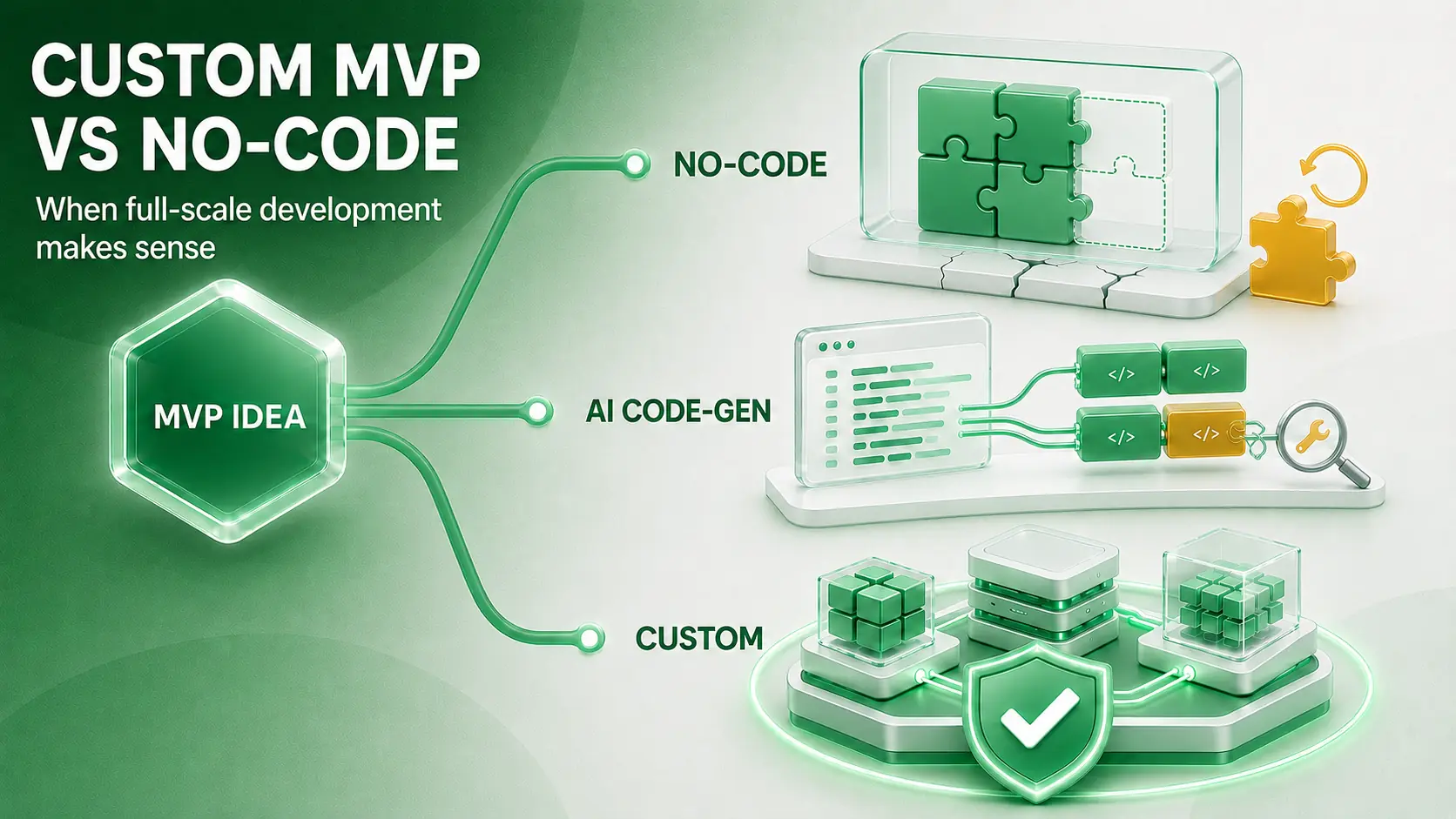
That’s why teams that are planning for scale from day one, or working with complex business logic, often choose custom development right from the start. Yes, it requires higher upfront investment, but it gives full control over how the product evolves - and how it will scale in the future. In the long run, this often results in lower total cost of ownership.
A typical story: a startup founder builds a working MVP on Bubble in two weeks. Early users leave positive feedback, and the product starts showing signs of product-market fit. Then an enterprise client comes in and asks for SSO, custom access roles, and integration with their internal CRM system. That’s where things start to break - because the platform simply doesn’t provide the tools needed to support these requirements. And this isn’t an edge case; it’s a pattern. Sooner or later, founders face the same decision: keep working around platform limitations or move to custom development. This article breaks it down honestly - when no-code is enough, and when it becomes a bottleneck for growth.
In simple terms, no-code is about using a ready-made platform with built-in constraints and predefined logic. You assemble the product from existing building blocks.
Custom MVP, on the other hand, is building a product from scratch around a specific business logic, without being tied to platform limitations. You design the system based on your own needs and use cases, reducing the risk that standardized components won’t fit your product requirements.
When No-Code Isn’t a Compromise, but a Strategy
No-code is a powerful tool, and an honest article has to acknowledge that upfront. There are at least four scenarios where no-code is objectively the right choice, and custom development would simply be a waste of money.
The first is hypothesis validation before investing in MVP development. If you’re not even sure the product is needed in the market, there’s no point in building a fully architected custom MVP from day one. At this stage, the goal is to validate the idea, not to ship a production-ready system. Building a clickable prototype in Bubble in a week and testing it with real users is faster and cheaper. If the hypothesis fails, you lose a week - not three months of development.
The second is a landing page or a simple waitlist. There’s almost no business logic involved beyond an email capture form. In this case, no-code is not just acceptable - it’s objectively the better option: faster, cheaper, and easier to iterate.
For landing pages, Webflow is arguably the best choice. It produces clean HTML/CSS, is well-optimized for indexing, and gives full design control without needing a developer.
The third is internal tools for teams. Airtable combined with Zapier is often enough to handle operational workflows: tracking requests, simple CRM processes, and automating repetitive tasks between services. This is not a customer-facing product, and the requirements are fundamentally different.
The fourth is an MVP with simple business logic, where the main priority is speed to market. If the product is essentially a form, a database, and a few screens, no-code can handle it without any issues.
In all of these scenarios, Custom MVP development services are unnecessary. Paying for architecture you don’t yet need is a poor decision at an early-stage startup. No-code clearly wins here - and acknowledging that is part of an honest conversation about choosing the right technology.
When No-Code Becomes a Risk
This is the core of the article, where it’s worth being specific rather than abstract. There are four common scenarios where no-code stops being a tool and starts becoming a limitation.
Custom business logic
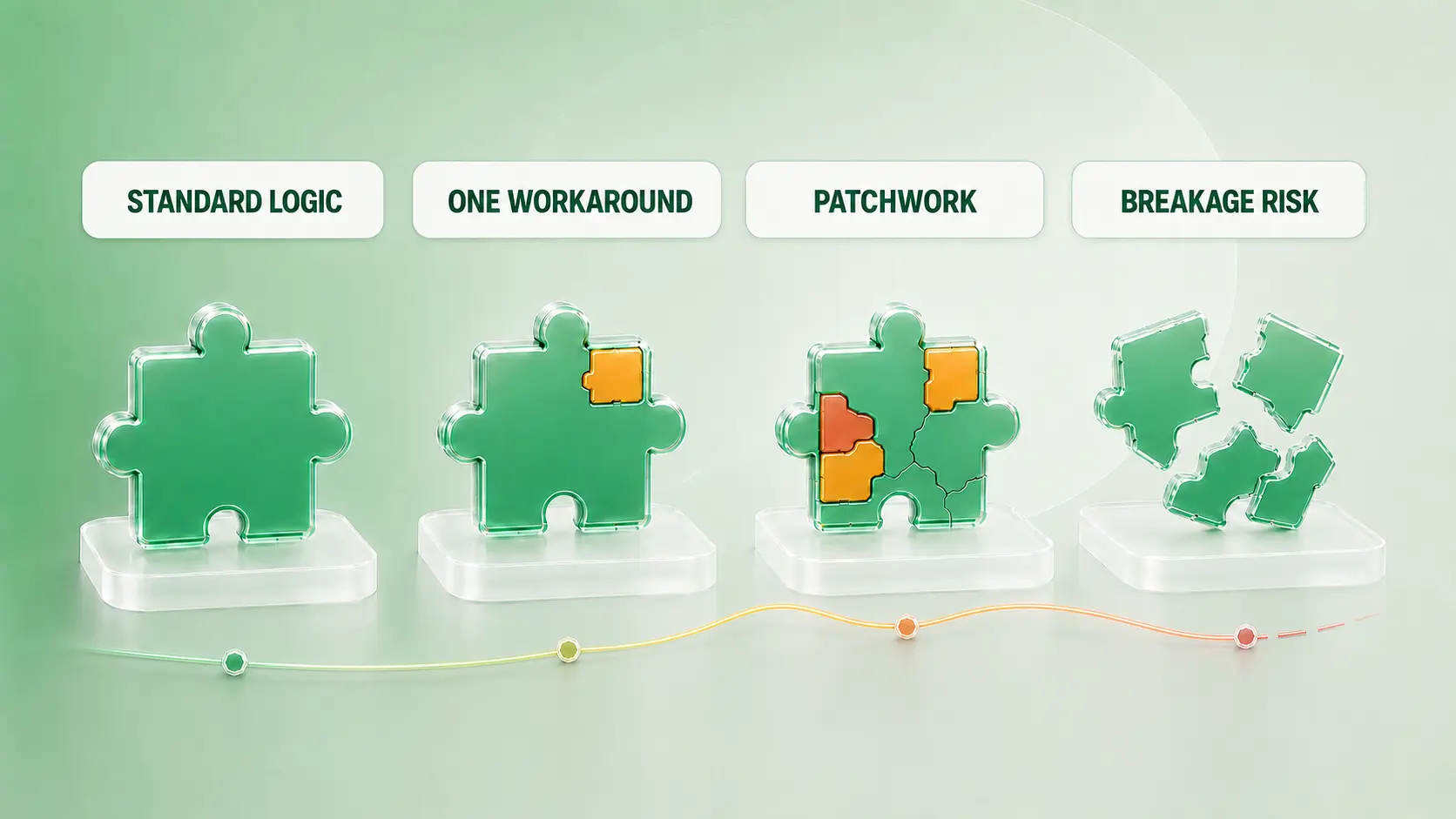
No-code platforms are built on predefined patterns - their creators have already anticipated a set of common use cases. The moment a business process moves beyond those patterns, teams start relying on workarounds. The first one feels acceptable. The second adds complexity. By the fifth, the system becomes so fragile that every new feature breaks something that already worked.
Complex pricing systems with dozens of conditions, multi-step workflows with branching logic, and role-based access rules all quickly turn a no-code project into a patchwork of workarounds instead of clean custom logic.
External system integrations
No-code platforms usually offer ready-made connectors for popular services - Stripe, Slack, Google Sheets. But what happens when a client uses a legacy ERP, a custom CRM, or a specialized banking API?
If there’s no native connector, teams often end up building custom webhooks inside tools like Bubble - which essentially stops being no-code at that point and turns into a half-custom solution with none of the benefits of either approach. Custom development, on the other hand, gives full control over the integration layer from the start and is not limited by what platform builders decided to support.
Performance at scale
No-code platforms run on shared infrastructure. You don’t control how code is executed, where data is stored, or how the database scales.
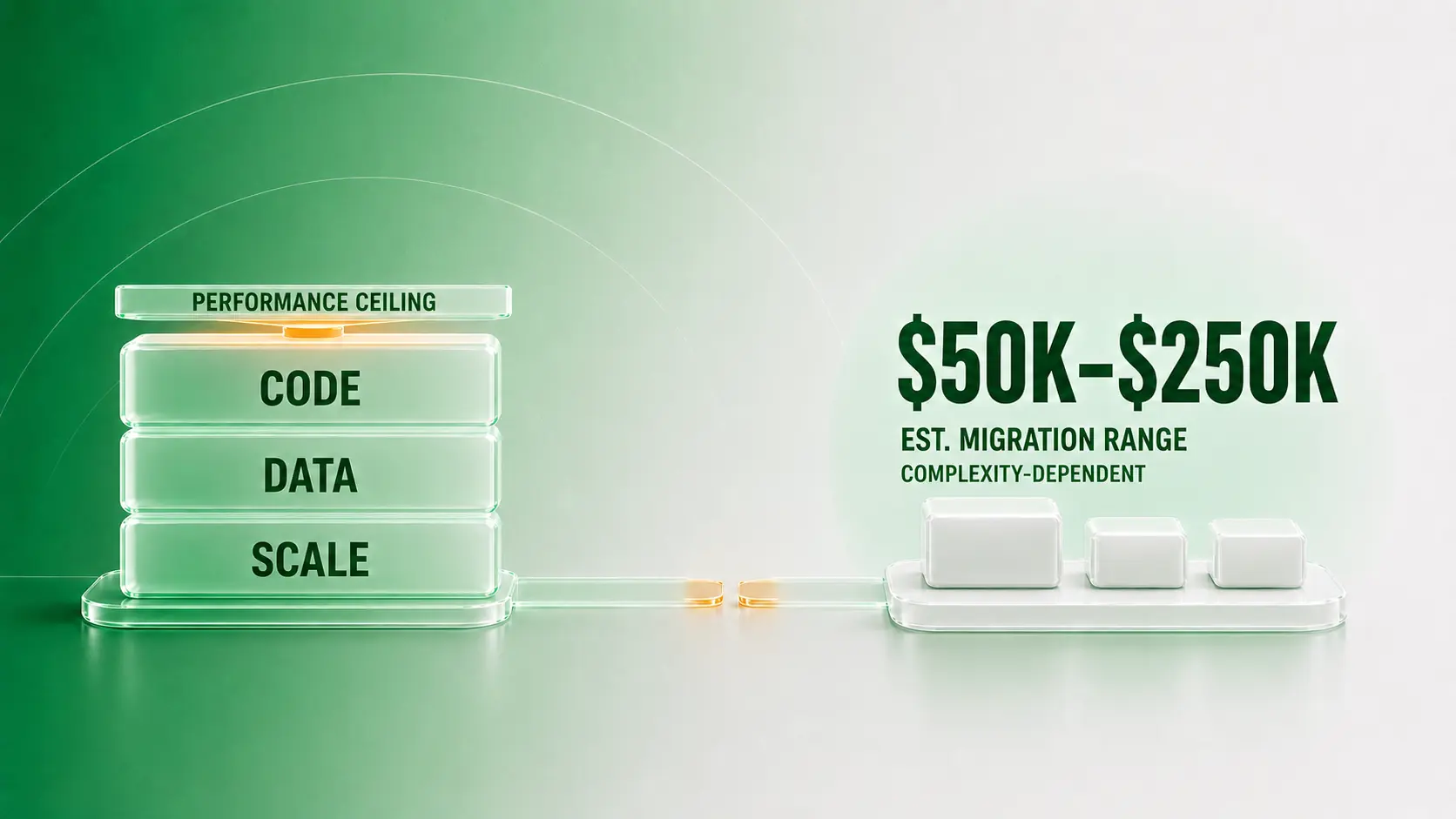
For 100 users, everything may work smoothly. For 10,000 concurrent users or compute-heavy operations, problems start to appear: latency increases beyond acceptable levels, request limits kick in, and you can’t directly optimize database queries. In the end, performance in no-code solutions becomes a ceiling set by the platform - not a limit you can extend.
Vendor lock-in on exit
Bubble, for example, does not allow exporting source code. If the product outgrows the platform, you essentially have to rebuild it from scratch.
This is not a hypothetical risk: by some estimates, 25–30% of no-code projects eventually go through a full rewrite. The cost of such a migration ranges from $50,000 to $250,000 depending on complexity.
AI and ML functionality
AI and ML are no longer "nice-to-have" features - for many digital products, they are part of the core functionality. No-code platforms offer integrations with OpenAI, chatbot builders, and other ready-made AI modules. If the goal is to quickly validate an idea or add a simple AI feature, this is usually enough.
The situation changes when AI becomes part of the product itself. Custom models, fine-tuning, RAG over internal company data, and complex data processing logic all require architectural and infrastructure control. This is where no-code starts to reach its limits. There’s a fundamental difference between integrating a ready-made AI service and building AI functionality that actually creates a competitive advantage.
The Third Path: AI Code Generation
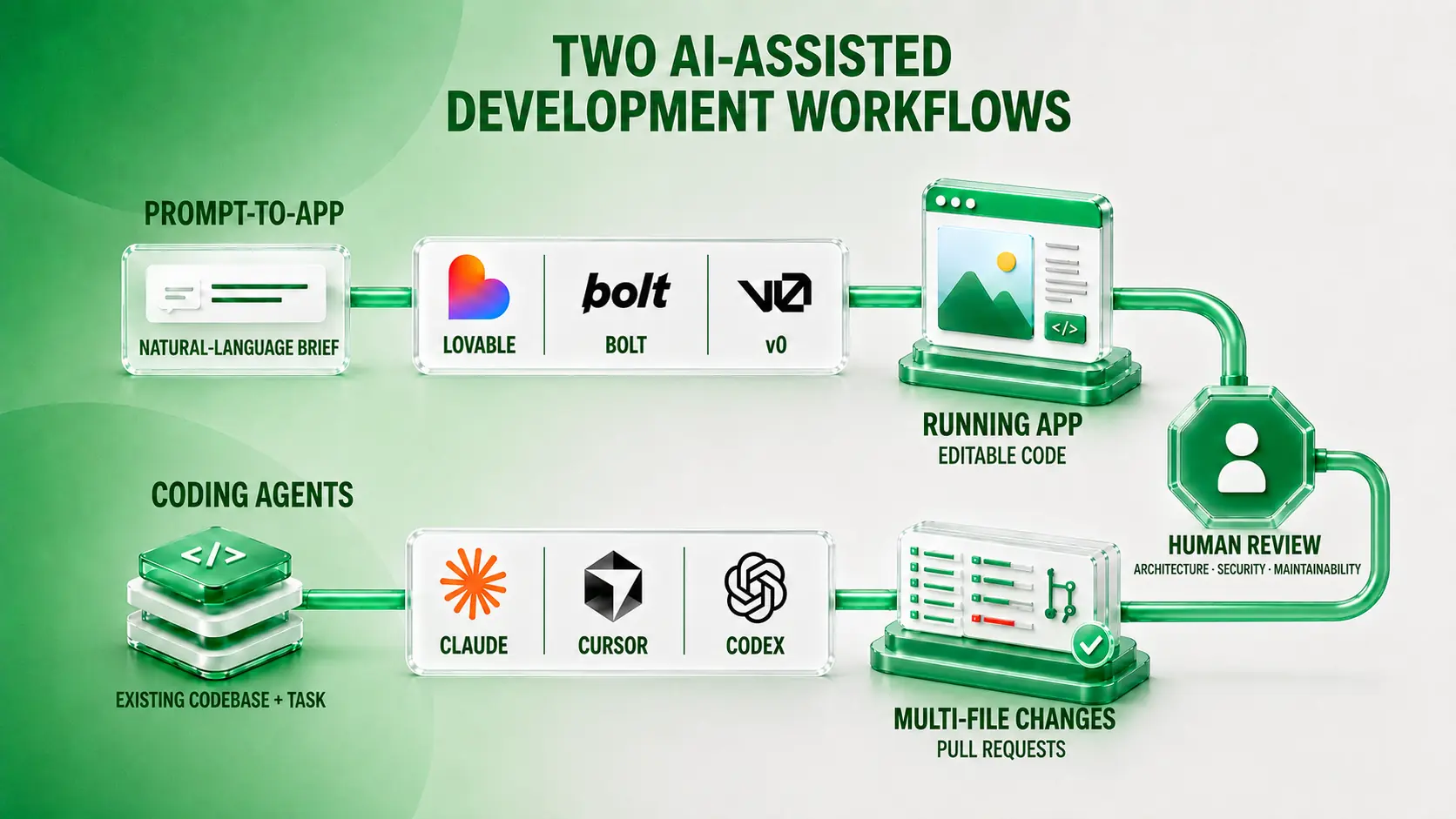
By mid-2026, AI code generation has split into two distinct tiers. Prompt-to-app builders (Lovable, Bolt, v0) generate a full running app from natural language - no-code’s speed, but the output is real code you own, with no Bubble-style export lock-in. AI coding agents (Claude Code, Cursor, Codex) work differently: they operate inside an existing codebase, handling multi-file changes and PRs, mostly as a productivity layer for teams that already know what they’re building.
Where it fits: standard SaaS MVPs without exotic logic, founders who want speed without the no-code migration cliff, and at least one technical person to review the output. Where it doesn’t: these tools still need a human who understands engineering to catch architectural and security mistakes - without that, AI-generated code accumulates the same kind of unmanaged debt as no-code, just dressed up as "real code." The speed gap with no-code has closed; the judgment gap hasn’t.
Control, Scale, and Freedom: The Custom Approach
A custom MVP is not just a "more expensive version of no-code." It’s a fundamentally different set of capabilities.
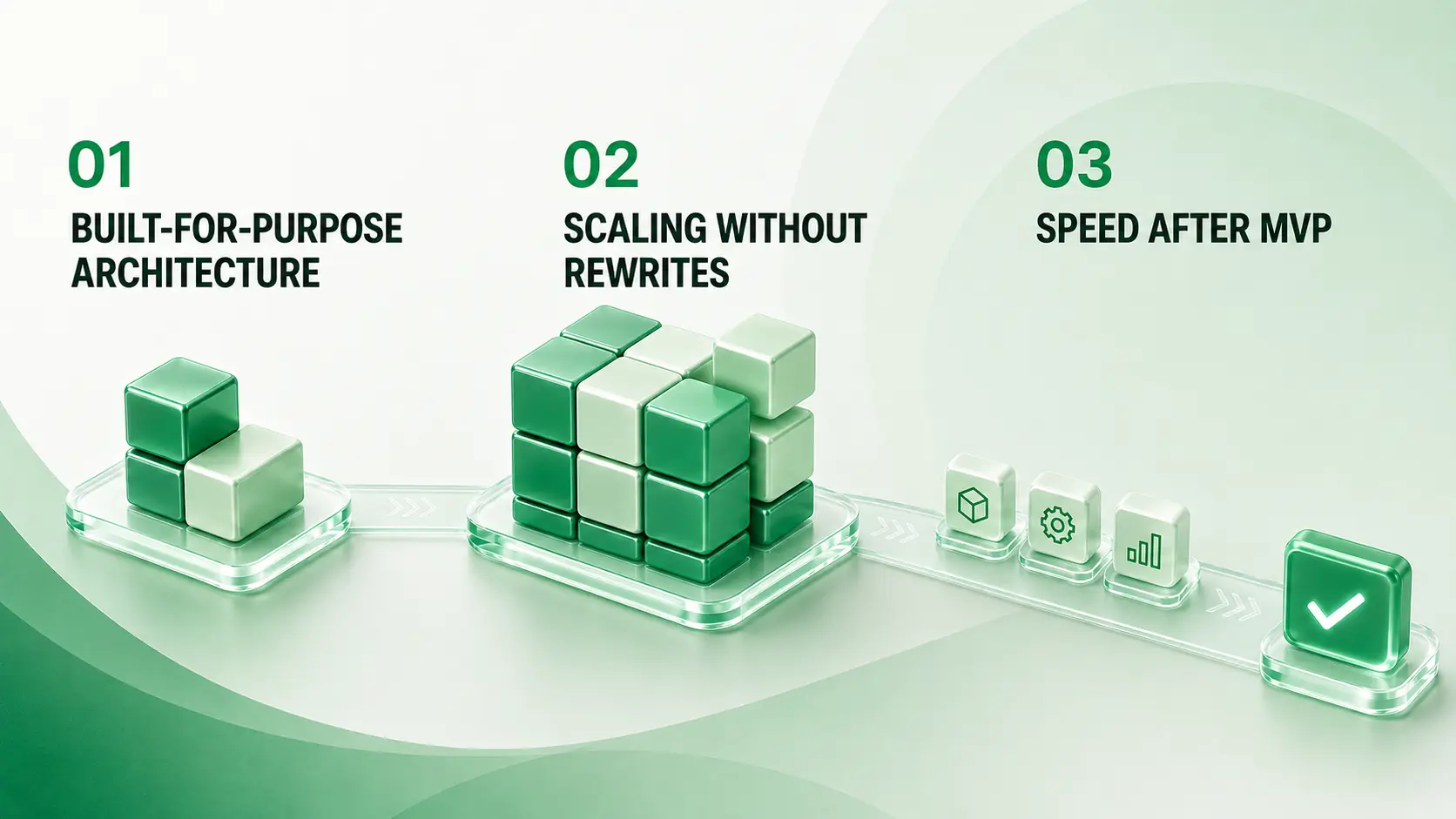
Built-for-purpose architecture. In custom development, you choose the tech stack based on product requirements - not platform constraints. Need real-time features? Use WebSockets. Heavy computations? Offload them to job queues. Need a specialized database optimized for specific query patterns? Nothing is stopping you.
Platforms define your boundaries. Custom MVP development gives you boundaries you define yourself.
Full data ownership and control. Where data is stored, how it’s encrypted, and who has access to it - all of this is fully under your control, not the control of a no-code vendor.
For B2B and enterprise clients, data ownership is often not a preference but a strict requirement. Compliance with GDPR, HIPAA, or SOC2 is extremely difficult to guarantee when your infrastructure is shared, opaque, and controlled by a third party.
Scaling without rewrites. A properly designed custom MVP can be built with horizontal scaling in mind from day one. There’s no need to migrate off a platform when the product grows - your infrastructure is already yours, and scaling happens within your own stack, not within the limits of someone else’s licensing model.
Speed after MVP. Here’s a paradox worth stating clearly: a custom MVP takes longer to build initially than a no-code prototype. But every feature after launch is typically faster to ship - the team understands the codebase, and platform limitations simply don’t exist as a category of problems.
Technical debt is accumulated deliberately and managed, rather than forced and unavoidable, as is often the case with no-code projects that outgrow their original constraints.
This is a decision every founder makes once - and then lives with for years.
That’s exactly how we build custom MVP software development services for our clients: starting with an architecture designed to handle growth, not one that needs to be rewritten after the first funding round. It’s not about making things more complex than necessary - it’s about not paying twice.
How to Know It’s Time to Move to Custom
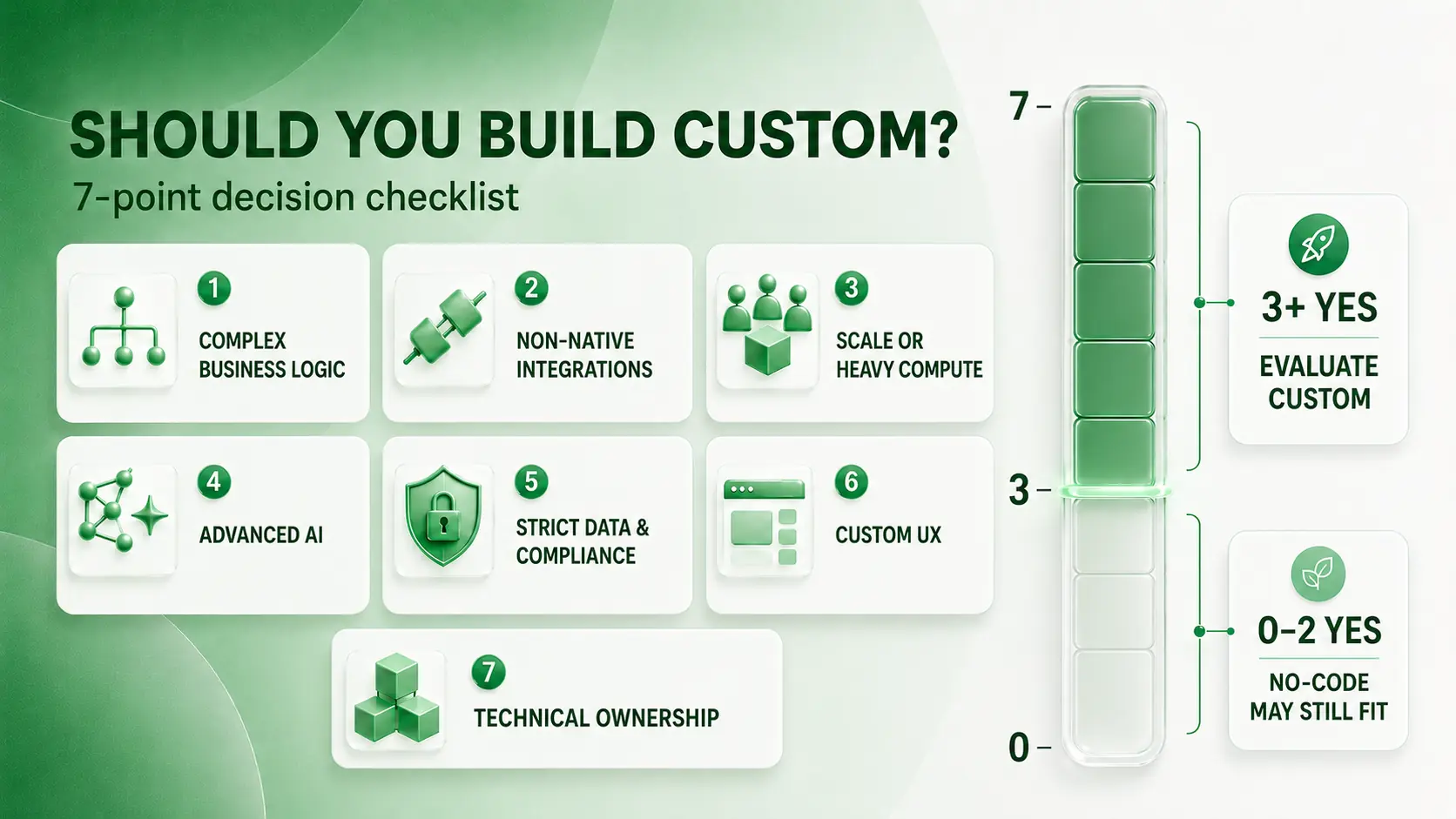
To avoid making decisions based on intuition alone, it helps to go through a simple checklist. Answer each question honestly with "yes" or "no". If you get three or more "yes" answers, there’s a high chance that no-code will soon start limiting your product’s growth.
-
Do you have business logic that is difficult to express using standard if/then scenarios? If your processes involve many conditions and exceptions, the platform may start creating more problems than it solves.
-
Do you need integrations with systems that don’t have ready-made connectors - such as legacy ERP systems, custom CRMs, or specialized banking APIs? In these cases, teams usually end up building workarounds or pushing beyond what the platform was designed to support.
-
Are you planning to reach more than 5,000 active users, or deal with compute-heavy operations (complex filtering, real-time features, large datasets)? In these scenarios, limitations of shared infrastructure often become visible: increased latency, request limits, and higher scaling costs.
-
Are you planning advanced AI features beyond standard chatbots - such as custom models, fine-tuning, or RAG over internal company data? Off-the-shelf AI modules usually cover basic use cases but don’t provide enough control for more advanced requirements.
-
Do your clients have strict requirements for data storage or compliance - such as GDPR, HIPAA, or SOC2? In such cases, "almost compliant" is usually not enough; full control over infrastructure becomes necessary.
-
Do you need a custom UX/UI that goes beyond standard builder components? If the interface itself is part of your competitive advantage, platform limitations become noticeable very quickly.
-
Is there a technical founder or CTO responsible for long-term product development? It’s worth remembering that custom development without architectural ownership can also create organizational rather than technical debt.
If you have three or more "yes" answers, it’s not a reason to change direction immediately. But it is a strong signal to evaluate custom MVP development solutions and assess whether your product is approaching the limits of its current platform.
The Final Breakdown: Where You Save and Where You Spend
Custom MVP development is more expensive upfront than no-code or AI-assisted development - no point pretending otherwise. But a no-code MVP rewritten in six months due to lock-in, or an AI-generated codebase nobody can maintain, often costs more in the end than building it properly from the start. The overspend isn’t in the initial budget - it’s the time lost rebuilding or untangling unreviewed output instead of shipping the roadmap.
Exact cost depends on business logic complexity, integration depth, compliance requirements, and team experience - no honest contractor gives a number without analyzing these first.
No-code and AI code generation are strong tools for validating hypotheses and shipping standard products fast. Neither is an architectural decision. If a startup has complex business logic that doesn’t fit templates or generic scaffolding, enterprise clients, and strict compliance needs, custom development isn’t a luxury - it’s an investment that typically pays off before Series A, when investors start asking questions a platform-based solution can’t answer.
A production-ready product built on a custom stack allows you to speak with enterprise clients and investors on equal terms - without excuses about platform limitations. A development team that builds on custom architecture from day one avoids platform lock-in and dependence on external decisions about how the product should scale.
If you’re currently facing this decision and want to understand what fits your product best, we offer custom MVP app development services from idea to production-ready release. As a custom MVP software development company, we work with projects where architecture actually matters, not just as a checkbox for investors. Free technical consultation - no pitch, no pressure, just a clear assessment of whether you need custom MVP development or whether no-code can still carry you for another year or two. Contact details below.