Building an MVP web application in 2026 costs between $15,000 and $150,000. The exact number depends on MVP product type, team location, feature complexity, and launch readiness. Most funded startups land between $40k–$80k for a solid MVP. A Proof of Concept starts at $8k; a market-ready product with billing, auth, and onboarding rarely comes in under $60k. If you're budgeting for an MVP web development company right now - this guide gives you the real numbers before your first call.
What is an MVP web application? A Minimum Viable Product (MVP) is the simplest working version of your software that delivers real value to real users. Not a prototype. Not a demo. A functional solution that covers one complete user scenario - enough to validate the idea, collect meaningful feedback, and justify the next round of investment.
A founder budgets $20k for a "simple web app." Three months later, costs hit $67k - and the product still isn't live.
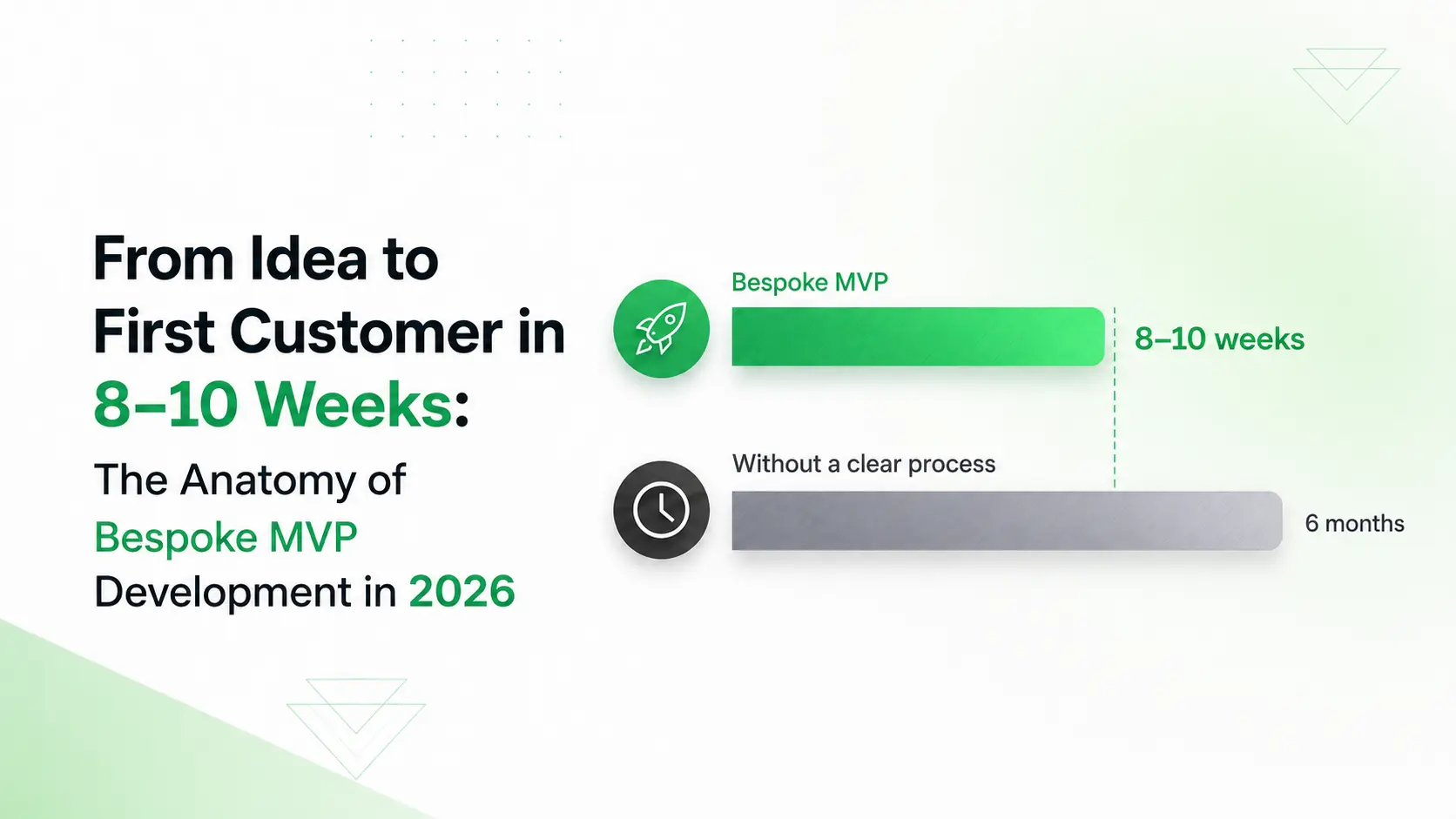
With experience across 50+ MVP web development projects - SaaS, marketplaces, and AI products, most web application MVPs fall between $15,000 and $150,000. The difference isn't the size of the idea. It's five specific factors we'll break down in this guide.
What You'll Learn in This Guide
- The real cost of MVP web development in 2026 - broken down by product type from $15k to $150k+
- 5 factors that determine your final number
- What's typically missing from agency quotes - and what it actually costs
- How to estimate your own MVP before talking to a single developer
- New trends shaping MVP web development services in 2026
- When building is the wrong move entirely
What Is an MVP Web Application in 2026
The difference between a Level 1 and a Level 3 MVP isn't just a list of features - it's a $140,000 price tag.
| Level | Name | What it is | Who it's for | Cost |
|---|---|---|---|---|
| 1 | Proof of Concept | Low-code prototype or wireframe. Validates the idea, not the product | Solo founders, idea stage | $2k–$8k |
| 2 | Functional MVP | Working product with a core user flow. Real users, real feedback | Startups with early traction | $15k–$60k |
| 3 | Market-ready MVP | Full auth, onboarding, billing, security, analytics | Funded startups, B2B, public products | $60k–$150k+ |
Most founders come in thinking they need Level 2. After the first scoping call, Level 3 becomes clear - because an MVP without billing, onboarding, and basic security isn't a viable product you can launch. It's a demo.
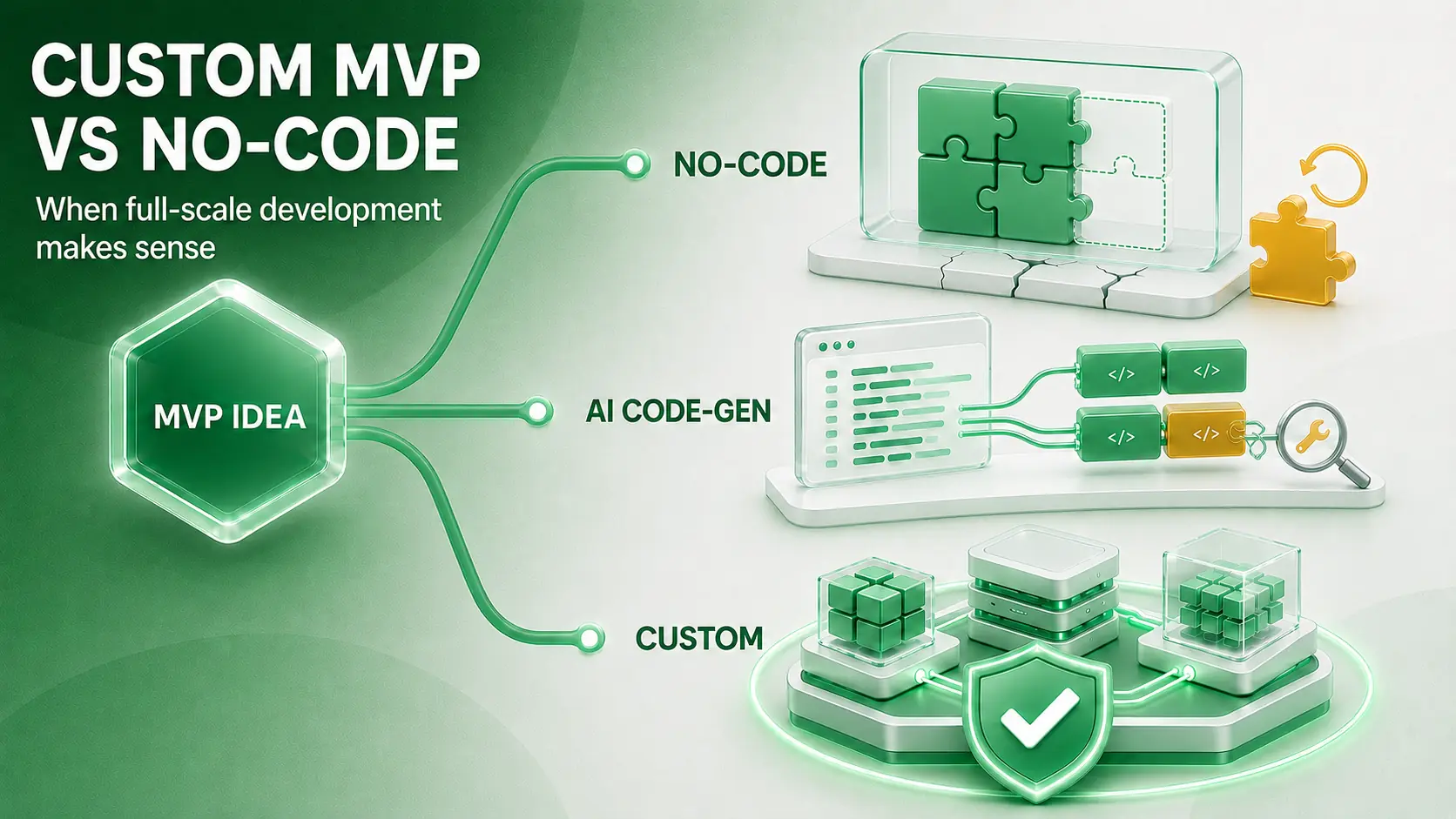
Low-code platforms like Webflow or Bubble work well for Level 1 - they're fast, cheap, and enough to validate demand before committing to full development. But they hit a ceiling quickly. The moment you need custom business logic, role-based access, or payment flows, you're building a real web application.
Understanding which MVP level you actually need is the most important question before any development starts. If you're planning a public launch or raising funding - you're almost always at Level 3.
MVP Cost Breakdown: Where Does the Money Actually Go
Most agencies give you one number for MVP web development. Here's what that MVP budget actually covers.
Functional MVP web app at $40,000:
| Component | Cost | What's included |
|---|---|---|
| Design | $8,000 | Wireframes + UI for 8–12 screens |
| Backend | $14,000 | Auth, database, 3 core APIs, Stripe |
| Frontend | $12,000 | Implementation, responsive design, 2 user roles |
| QA | $6,000 | Manual + basic automated testing |
Design at $8k isn't "drawing a few screens." It's UX logic: how users move between states, what happens on error, what the empty state looks like, how the app adapts on mobile. Cheaper design means developers answer these questions during coding - and that always costs more.
Backend at $14k isn't just "writing an API." It's data processing logic, server-side validation, error handling for every scenario, request security, database transactions. Every API endpoint has not just a happy path, but at minimum 3–5 failure scenarios that need explicit handling.
QA at $6k isn't "checking if things work." It's test cases for every user flow, edge case verification, regression testing after changes, and a pre-launch audit. If QA doesn't have its own line in the estimate - it's either buried in the backend or forgotten. Either way, that's a problem.
5 Factors That Determine Your MVP Development Cost
1. Feature Complexity - The Main Cost Driver
The number of user roles, business rules, and edge cases determines MVP development cost more than anything else. Each additional role means a separate flow, separate permissions, separate testing: +$3–8k.
A SaaS MVP web application with three roles (admin, manager, user) is already mid-complexity - budget from $35k. Add different access logic per pricing tier, and you're at $50k+, even if the individual features seem simple.
2. Team Format - The Balance Between Cost and Control
| Team Format | Description |
|---|---|
| Agency | Predictable end-to-end delivery. Worth it if you don't have a technical co-founder - you're paying for the process, not just the code. |
| Freelancers | Better ROI for the same skill level, but only with a PM on your side. Without coordination, three freelancers aren't a team. |
| In-house | A 3+ year investment. Hiring and onboarding takes 2–3 months before development even starts. |
3. Geography - Rates Vary Significantly Even Within Regions
| Region | Senior Developer Rate |
|---|---|
| USA / Canada | $130–180/hr |
| Poland, Czech Republic | $80–110/hr |
| Ukraine, Romania | $45–70/hr |
| Georgia, Serbia | $35–55/hr |
| India | $20–40/hr |
An MVP web development project at $80k with a US team costs $35–50k with a Central European team - same timeline, same scope.
4. Third-Party Integrations - Each One Is a Separate Sprint
Stripe, Twilio, AWS S3, OAuth - every integration means separate logic, separate testing, +$1–5k, and roughly a week added to the timeline. Budget them as separate line items, not as part of "backend."
"Just add Stripe" in practice means webhook handling, subscription logic, failed payment flows, refund edge cases, tax calculation. That's not a day of work - it's a full sprint.
5. Deadline Pressure - Urgency Has a Price Tag
The requirement to "ship in 6 weeks" is a financial decision, not an organizational one. Compressed timelines mean more people working in parallel, less time for code review, and higher risk of errors that cost twice as much to fix post-launch. Deadline pressure can add 30–50% to your budget - and that's a conservative estimate.
Real MVP Web Development Costs by Product Type
SaaS MVP Dashboard - $25k–$55k
The main cost driver is the number of roles and complexity of access logic. Two user roles cost one price. Four roles with different permissions depending on the pricing plan cost a completely different amount. If you're evaluating MVP web application development partners, this is the product type where scope creep happens fastest - nail down roles and permissions before signing anything.
MVP Marketplace - $60k–$120k
Two separate user flows (buyer and seller), search, split payments, ratings and reviews. Every MVP marketplace component has its own backend logic, edge cases, and testing cycle. Marketplaces cost more not because of more features - but because trust and safety is a full standalone system: user identity verification, dispute resolution logic, returns with split payment handling, basic fraud detection. That's why a marketplace that "looks simpler than Airbnb" rarely costs under $70k.
AI-Native MVP - $40k–$90k
Not "an app with an AI button." A separate architectural category: LLM integration, RAG pipelines, vector databases, rate limiting, context management, and fallback logic for API failures.
Where AI actually makes sense: text automation (generation, classification, summarization), semantic search and recommendations, content personalization based on user behavior.
The common mistake: "We added GPT - now we have a product." GPT is a tool. The product is everything around it - what context you pass to the model, how results are shown to the user, what happens when it fails.
B2B Internal MVP Tool - $15k–$35k
Minimal UX requirements, basic functionality for a specific team's needs, often an existing company design guide. It's the most focused MVP format and the best starting point for validating a web app idea without unnecessary complexity.
| Product Type | Range | Timeline | Main Cost Driver |
|---|---|---|---|
| SaaS Dashboard | $25k–$55k | 8–14 weeks | Number of roles |
| Marketplace | $60k–$120k | 16–24 weeks | Trust & safety system |
| AI-Native App | $40k–$90k | 10–18 weeks | LLM architecture + API costs |
| B2B Internal Tool | $15k–$35k | 5–10 weeks | Minimal scope |
What's Not in the Typical Agency Quote
Critical components without which the product cannot be launched or maintained:
- Infrastructure and deployment - CI/CD setup, cloud configuration, environment management: $2–5k one-time. Skipping this means manual deployments and broken staging environments.
- Security basics - rate limiting, input validation, environment variables: often $0 in the quote, never $0 in the work.
- Post-launch QA and fixes - 15–20% of development budget. The first month after launch always costs more than expected.
- Monitoring - Sentry or basic alerts: $50–200/month. Without it, you won't know what broke or when.
Secondary but necessary expenses:
- Legal setup - GDPR, Privacy Policy: $1–3k. For AI products, add $2–5k for EU AI Act compliance.
- UX iteration - 2–3 rounds of revisions after first user feedback. Real users will iterate your assumptions fast.
- Onboarding content - tooltip copy, email sequences, empty state messaging. Developers don't write this, and it directly affects early user engagement.
Together, post-launch realities add 25–40% on top of your development budget. A $40k MVP estimate becomes $50–56k before your first user logs in.
MVP Development with AI Tools: What Actually Changed in 2026
AI-assisted development is now the default, not the exception. Teams using Cursor, GitHub Copilot, and Claude Code ship MVP boilerplate 30–40% faster. That's real. But "an MVP in 3 weeks with AI" needs unpacking.
What AI tools genuinely improve:
- Boilerplate generation - auth scaffolding, CRUD endpoints, form validation.
- Test writing - unit and integration test coverage that used to take days.
- Code review - catching obvious issues before human review.
- Development efficiency - especially for mid-level developers on well-defined tasks.
What AI tools don't solve:
- Scalability and performance. The architecture looks fine at 200 users. At 2,000, the system starts slowing down in places nobody anticipated. An LLM generates code that works today - a senior developer owns the architecture that holds tomorrow. Refactoring for scalability costs significantly more than getting it right from the start.
- Prompt engineering for your product. RAG pipeline design requires vector database selection, chunking strategy, embedding model choice, and fallback logic. This is a separate architectural layer, not a feature you toggle on. Getting insights from user data through AI requires just as much backend thinking as any other data system.
- Code consistency. Different parts of the product get written in different styles. Every new feature becomes more expensive because developers first have to understand "how this part works" before writing a line of code. This kills long-term efficiency.
Real cost implications of AI-native MVPs:
- LLM API costs: $500–$3,000/month ongoing, regardless of user volume.
- EU AI Act compliance audit: $2–5k for any B2B or public-facing AI product.
- Refactoring AI-generated code: typically 20–30% of the next development cycle if architecture wasn't owned by a senior from day one.
The honest summary: AI tools reduce time on execution. They don't reduce the need for judgment on what to build, how to structure it, or whether it will scale.
Agency, Freelancer, or In-House: Choosing Your MVP Web Development Team
| Parameter | Agency (US/EU) | Freelancers | In-house |
|---|---|---|---|
| Speed to start | High | Medium | Low |
| Predictability | High | Variable | Depends on hiring |
| Cost | High | Medium | Medium + equity |
| Control | Limited | Full | Full |
One MVP - three scenarios:
- Agency (US/EU): $80k, 14 weeks, full team delivered.
- Freelancers (Central Europe): $35–50k, 18 weeks - but you need a PM on your side.
- In-house (senior + junior): $55k over 6 months.
Simple decision rule: no technical co-founder → agency. Have a technical co-founder → freelancers. 3+ year core product → in-house.
How to choose an MVP web development company:
- Portfolio of real MVP web applications that shipped - not corporate websites.
- Clear explanation of pricing model: Fixed-price or T&M, and why for your specific project.
- Dedicated PM - not a developer who "also communicates".
- References from startups, not enterprise clients.
How to Cut MVP Web Development Costs Without Losing Quality
-
Lock down MVP scope ruthlessly. Define the core loop - the single action that delivers value - and freeze everything else as v2. This alone saves 20–40% of the total budget.
-
Use existing auth solutions. Clerk, Auth0, or Supabase Auth are production-ready in a day, not a sprint. Building custom authentication from scratch is one of the most common ways early-stage startups waste two to three weeks of development time.
-
Don't build your admin panel. Retool or native Supabase UI covers 90% of internal needs at a fraction of the cost. Save $5–10k and build it properly in v2 when you know what you actually need.
-
Start small on infrastructure. Vercel and managed databases are the right starting platforms for most MVP web applications. Paying for scale-ready servers before you have real users is one of the easiest $3–8k to waste.
-
Use AI-assisted development intentionally. Cursor and GitHub Copilot cut boilerplate and test writing significantly - especially for mid-level developers. The key word is intentionally: with a senior developer setting the architecture and reviewing output, not replacing that judgment.
When MVP Web Development Is Still Too Early
Before commissioning any MVP web development services, there are things you can validate without writing a single line of code.
- Step 1. User research interviews. Before any MVP development begins, run 10–15 conversations with your target audience. Focus on how they solve the problem today - what tools they use, what workarounds they've built, what they'd pay to eliminate. This gives more actionable insights than any prototype.
- Step 2. Landing page with a waitlist. Build a static page (Webflow, Carrd) with a "Join the beta" button. Got 30 emails from 1,000 visitors? Move forward. Only 3? Iterate on the positioning or the problem before touching any code.
- Step 3. Manual MVP. The manual MVP approach works like this: instead of automating, do it yourself. The user submits through a form, you process manually. This validates that people will pay for a solution to this problem before you've built anything.
- Step 4. Figma prototype. Before committing to MVP development, invest $1–3k in a clickable design. If testers don't understand the flow on screen, there's no point building the backend behind it. Test the core functionality before any software gets written.
MVP Web Development Cost Calculator
Run this MVP cost estimate before your first call with any web development company. Use it as your MVP scoping baseline.
| Module | Low complexity | Medium | High |
|---|---|---|---|
| Auth & registration | $2–3k | $4–6k | $8–12k |
| User profile | $1–2k | $3–5k | $6–10k |
| Core functionality | $5–8k | $10–20k | $25–50k |
| Payment integration | $3–5k | $6–10k | $12–20k |
| Notifications | $1–2k | $3–5k | $6–10k |
| Admin panel | $2–4k | $5–10k | $12–20k |
| Analytics & reporting | $2–3k | $5–8k | $10–18k |
| 3rd party integration | $1–3k | $3–6k | $7–15k |
If your total exceeds $80,000, you're most likely building a V1, not an MVP.
2026 Trends Changing MVP Web Application Development
- AI-First MVP Products. AI is no longer a feature - it's a development approach. Logic is built around language models, RAG, context management, and vector databases. "Just adding AI" is no longer a product decision - it's a marketing line.
- Vibe Coding and MVP Speed. Tools like Cursor, GitHub Copilot, and Claude Code have become the standard. They genuinely accelerate development. But code consistency and scalability still require human judgment at the architecture level.
- Serverless-First MVP Architecture. The smartest starting strategy for most modern MVP web projects. Lower upfront costs, faster deployment, automatic scaling. Paying for dedicated servers before your first thousand real users simply doesn't make sense.
MVP Web Application Development in 2026: It's About Value, Not Features
An MVP is not a feature list. It's one complete scenario where a user gets real value - and walks away understanding what your software does and why it's worth paying for.
MVP budget problems almost always start before development begins: unclear scope, underestimated integrations, unplanned post-launch costs. MVP cost is determined not by the idea itself, but by the number of roles, integrations, and complex scenarios. The gap between $40k and $80k is usually about launch-readiness - not feature count.
If the MVP budget feels too high, the issue is usually scoping, not price. The key question: what do you really need for users to experience the core value of this product? Everything else is v2.
Looking for an MVP web application development partner? Start with the checklist in the Agency section above - it applies whether you're evaluating a large studio or a three-person team.