When AI in Your Product Is a Trap, Not an Advantage
Every year, thousands of startups kick off MVP development with the same words: "we need AI." Not because they’ve clearly defined what problem it will solve. But because everyone else is doing it, because investors expect it, because it sounds compelling in pitch decks. The result: budgets burn twice as fast, launches slip by months, and the product hits the market more complex and more expensive than it needed to be.
But there’s the opposite extreme too. Some startups avoid AI even where it could become a genuine competitive advantage - out of fear of costs, or simply not understanding how to integrate machine learning into their product logic. They end up losing ground to competitors who made the right bet at the right time. Both mistakes are expensive. And both happen for the same reason: teams don’t understand the fundamental difference between an AI MVP and a regular MVP - a difference that goes beyond cost, touching risk logic, validation approach, team structure, and expectations for the outcome.
One thing I’d argue most articles on this topic miss entirely: an AI MVP actually tests your idea worse than a simple MVP. Not because AI is bad - but because it adds a layer of complexity that makes it much harder to read the market signal clearly. That’s the core idea this article is built around, and it changes how you should be thinking about the whole decision.
I’ve been through dozens of these projects - as a developer, as a technical lead, as a consultant. I’ve watched teams spend $80,000 on AI features that no user ever touched. I’ve seen the wrong choice between Regular MVP development and AI MVP development turn into blown budgets and lost months. And I’ve seen properly integrated ML transform a niche SaaS product into a scalable solution that competitors can’t easily replicate.
This article is a straight, no-hype breakdown: what actually separates an AI MVP from a regular MVP, how that affects budget, timelines, and risk, where AI is genuinely needed and where it just makes idea validation harder, and how to use a simple framework to make the right call for your product.
What a Regular MVP Is: The Baseline
Before talking about AI MVP development, it’s worth locking down what a classic MVP actually is - and why it remains the best starting point for most early-stage products.
A regular MVP is the minimum set of features needed to test a product’s core hypothesis with real users. No unnecessary complexity. No "just in case" scope creep. Only what’s required to get the first market feedback and confirm or disprove the key assumptions about your product.
Technically, that means a standard full-stack backend and frontend architecture, a relational or document database, basic business logic, and minimal cloud infrastructure. Predictable code, straightforward tests, simple deployment.
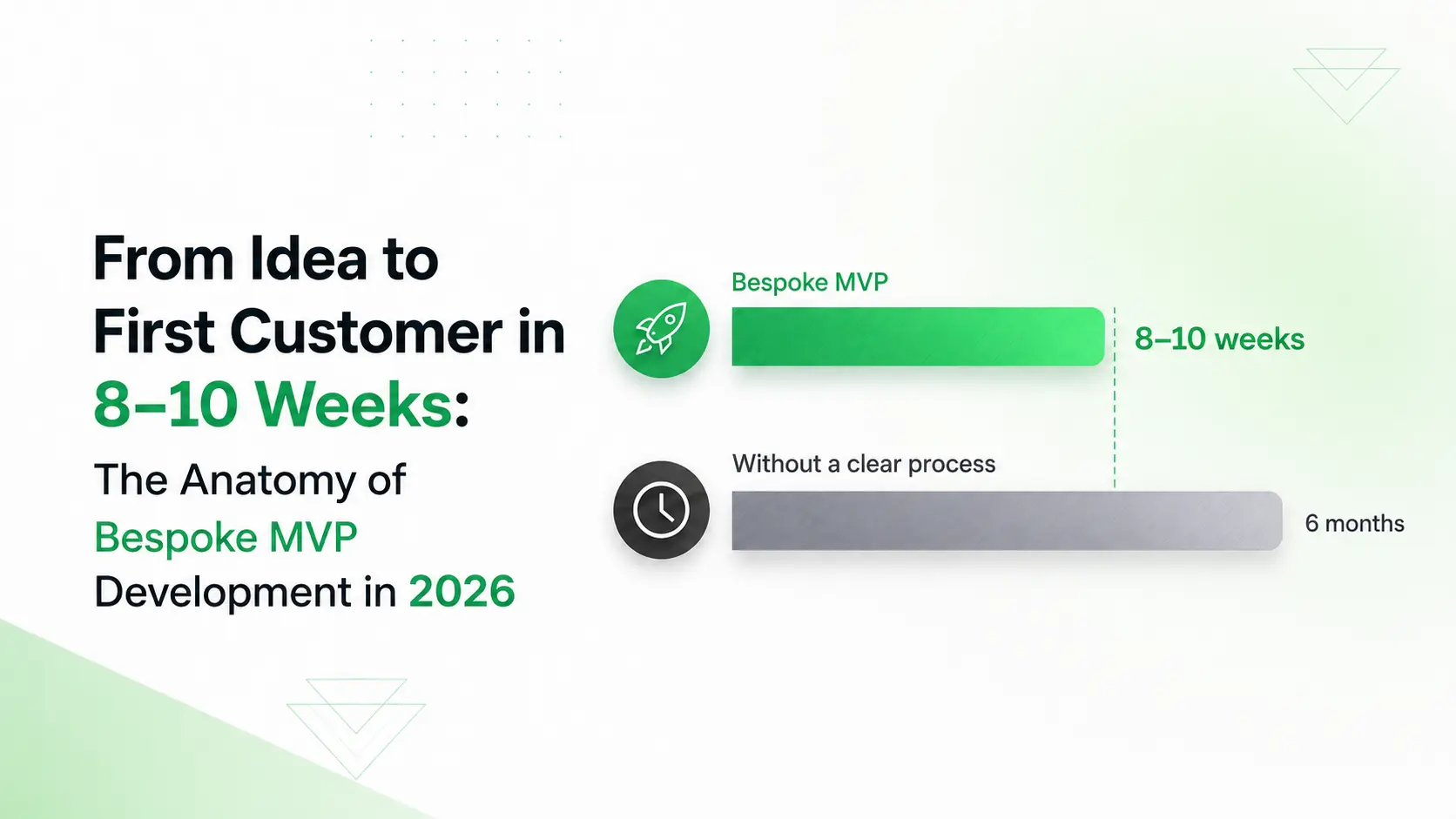
From a cost perspective, the picture is equally predictable. Most Regular MVPs for startups land in the $10,000–$40,000 range depending on feature complexity and team size. Timeline: 4 to 12 weeks to the first working release. These are real numbers from real projects, not marketing promises from a landing page.
But the most important thing about a regular MVP isn’t the price - it’s the predictability of the development process. Product managers can build a clear backlog. Engineers can estimate tasks accurately. QA can write test cases before a single line of code is written. There are no hidden risks like "what if the model gives wrong results" or "what if we don’t have enough training data." The whole team - from engineers to business stakeholders - knows what’s being built and when it will be ready.
That predictability is the core value of a Regular MVP. Regular MVP development is the fastest, cheapest way to test a hypothesis without unnecessary risk. You’re not building a final product - you’re running a controlled experiment. Market uncertainty stays, but technical uncertainty is minimized.
Regular MVP development services typically offer a clear timeline and predictable budget - exactly what an early-stage team needs to learn quickly and iterate. AI MVP development services, by contrast, rarely offer those same guarantees.
That’s exactly the predictability an AI MVP breaks - and it breaks it at every level.
What an AI MVP Is and Why It Changes Everything
An AI MVP is not "a regular MVP with an ML feature bolted on top." It’s a fundamentally different type of product, where artificial intelligence is part of the core value proposition - not a convenience layer or cosmetic improvement.
What does that mean in practice? If your product generates content for users, builds personalized recommendations based on behavior, automates manual workflows through pattern recognition, classifies or sorts objects in real time, or provides predictive analytics - you’re building an AI MVP. AI isn’t a feature here. It is the product.
Concrete examples across industries: a personalized content recommendation platform where there’s simply nothing to show users without ML. A tool for automated legal document analysis using NLP - without AI it’s just a text editor. A customer support chatbot using an LLM to generate contextual responses - without AI it’s just a FAQ. A predictive analytics system for churn forecasting - without an ML model it’s just a dashboard with metrics. In all these cases, AI doesn’t just improve the product - it defines it.
On cost, the picture looks very different from a Regular MVP. The ranges below assume a typical startup working with an external development team on a production-ready scope - not a solo founder using no-code tools or an in-house team building a throwaway prototype.
With that context: AI MVP development services at a basic scope - integrating a ready-made LLM API, simple workflows, minimal customization - realistically start at $30,000–$60,000. Mid-level scope with RAG architecture, custom pipelines, and proper MLOps typically lands at $80,000–$150,000. More complex cases involving custom fine-tuning, agentic systems, enterprise compliance, or large data volumes generally run $150,000–$300,000+. These aren’t marketing estimates - they’re realistic ranges based on architectural decisions we’ll cover shortly. And this is only the initial development cost. The full cost structure is significantly more complex, and we’ll break it down in the next section.
The most important insight that most founders ignore during planning: this isn’t just more expensive development. It’s a fundamentally different type of project.
When you build a Regular MVP, you know what you’ll get: a product with defined features and predictable behavior. When you build an AI MVP, you don’t know in advance whether the model will be accurate enough for real use. Whether you’ll have enough data to train it. Whether users will actually like the behavior of an AI-powered product.
An AI MVP is an experiment, not just a build. The outcome isn’t guaranteed even with perfect execution. That’s why AI MVP development services cost more, take longer, and require a different planning approach than a standard MVP development project. The gap between what an AI MVP promises and what it delivers at launch is almost always wider than founders expect.
This changes the entire product logic - not just the price, but team structure, planning approach, success metrics, and timeline expectations.
Three Decisions That Define the Real Complexity of an AI MVP in 2026
Before comparing numbers, it’s worth understanding that "AI MVP" in 2026 is not a single technology. It’s a spectrum of architectural approaches with fundamentally different costs, complexity levels, and risk profiles. Three questions need to be answered before development starts.
1. Plain LLM API, RAG, or Fine-Tuning?
In practice, this is one of the most consequential decisions for any AI MVP today, and the answer shapes the budget more than almost any other factor.
A ready-made LLM API (OpenAI, Claude, Gemini) is the fastest start. You send requests to the model and get responses. Minimal initial development, but full dependency on the provider and the highest cost at scale. Works well for MVPs where you need to quickly validate a concept. For a startup working with an external development team, expect $20,000–$40,000 in development cost - though a solo founder using existing tooling can do it for significantly less. Operational costs can climb to $3,000–$8,000/month under real production load.
RAG (Retrieval-Augmented Generation) is the sweet spot for most product use cases. You build a vector knowledge base from your own data and pull relevant context into LLM prompts. The result: the model "knows" your product, documentation, and clients without expensive fine-tuning. RAG architecture in 2026 is the standard for AI-powered content tools, customer support, and enterprise knowledge bases. For a production-ready implementation with an external dev team, expect $50,000–$120,000 - but model behavior is far more controllable and hallucinations are significantly less frequent.
Fine-tuning means training or adapting a model on your own data. You need it when RAG doesn’t cut it: a specific generation style, highly specialized domain terminology, strict consistency requirements. Fine-tuning requires large volumes of quality training data, significantly more development time, and ongoing retraining. In practice, this means $100,000+ upfront and continuous costs whenever your requirements shift.
A pattern that works well in most cases: start with an API, move to RAG when you need domain specificity, and consider fine-tuning only when RAG hits a concrete quality ceiling that you’ve actually measured.
2. Agentic Systems: The New Normal, New Complexity
In 2026, a significant portion of AI MVPs are being built not on LLMs that respond to queries, but on AI agents - systems where the model independently plans actions, calls tools, and executes multi-step tasks without constant human involvement.
Common examples: an AI agent that independently researches a topic, collects data from multiple sources, and produces a structured report. A sales agent that analyzes your CRM, finds potential clients, and drafts personalized outreach. A DevOps agent that monitors systems, diagnoses issues, and executes standard remediation workflows.
Agentic systems unlock automation opportunities that previously required significant manual labor. But they add a separate dimension of complexity: unpredictable behavior, harder testing, higher cost of failure, and the need for robust guardrails. An agentic AI MVP can easily cost twice as much as a simple LLM integration approach - and requires significantly more time to ensure reliability in production.
As a general rule: agentic systems make sense at the MVP stage only when multi-step autonomous execution is the core value your product delivers - not a convenience feature layered on top. If the same outcome can be achieved with a simpler request-response flow, agents add unnecessary risk without proportional benefit at this stage.
If your MVP does require agentic workflows, budget not just for development but for dedicated time testing edge cases and constraining agent behavior.
3. LLM Evaluation: Accuracy Isn’t Enough Anymore
One of the biggest traps in AI MVP development in 2026: teams ship a product having only checked basic answer accuracy. That’s nowhere near enough.
A real production AI product requires systematic evaluation across several dimensions:
- Hallucination rate - how often the model confidently outputs false information. For most products, an acceptable threshold is below 1–2%, but without systematic measurement you simply don’t know your real number.
- Latency - response time directly affects user experience. An acceptable threshold for most chatbots and AI features is under 2–3 seconds. Agentic systems can take 10–30 seconds, which requires a separate UX approach.
- Cost per task - what a single AI operation costs under real load. Without this metric you can’t build realistic unit economics for your product.
- Consistency - whether the model gives equivalent answers to semantically identical queries. Inconsistency destroys user trust in an AI product faster than almost any other problem.
Building an evals system isn’t a post-launch bonus - it’s a mandatory part of AI MVP development. If your team or your AI MVP development services provider doesn’t include evals in the project scope, that’s a serious red flag.
AI MVP vs Regular MVP: The Real Differences
Here’s a concrete breakdown of the key parameters where these two approaches fundamentally diverge. This isn’t theoretical - it’s what every team runs into during AI MVP implementation or classic product MVP development.
| Parameter | Regular MVP | AI MVP |
|---|---|---|
| Development process | Predictable delivery. Spec → build → QA → release | Constant iteration loops. Data prep, fine-tuning, unpredictable delays |
| Cost structure | One-time development spend. Fixed price or clear T&M | Dev + data + API costs + MLOps + ongoing support. Costs grow after launch |
| Budget | $10,000–$40,000 | $30,000–$300,000+ depending on scope and architecture |
| Time to market | 4–12 weeks | 3–6 months. Rapid launch is the exception, not the rule |
| Risk | One type: market risk. The idea either works or it doesn’t | Double: market + technical. Two independent sources of uncertainty |
| Validation clarity | Clean signal from the market. You know what’s working | Noisy signal. Hard to separate AI problems from product problems |
| Value potential | Baseline value, sufficient to test the hypothesis | Potentially strong differentiation - if everything works |
| Team | Full-stack engineers + PM + QA | + ML engineers, data scientists, MLOps |
Key takeaway: An AI MVP is not a more expensive version of a regular MVP. It’s a different product economy with different risk logic and a fundamentally different way of defining success at the early stage. Choosing between Regular MVP development and AI MVP development is choosing between two different go-to-market strategies with different risk profiles and different potential outcomes.
The Real Cost Breakdown: What’s Hidden in the Numbers
The biggest mistake founders make is counting only initial development and ignoring operational costs. That’s where the most unpleasant surprises are hiding.
Regular MVP: cost structure: Transparent and predictable. Dev hours: $8,000–$30,000. Cloud infrastructure on AWS or Azure: $50–$300/month. Budget is simple, planning is reliable.
AI MVP: full cost structure: The picture is fundamentally more complex. Broken down by category:
- Dev hours: Significantly higher due to AI engineering complexity. $20,000–$70,000+ just for development. ML engineers and data scientists cost more than standard developers, and their work takes longer due to the exploratory nature of ML tasks - where the first approach is rarely optimal.
- Data preparation: Chronically underestimated in most projects. Collecting, cleaning, normalizing, labeling, and validating data for model training and testing can cost $5,000–$20,000 and take weeks to a month. Data quality directly determines model quality. Without quality, representative, properly labeled data, no AI will perform in production the way you expect.
- API and ongoing model costs: If your product uses OpenAI, Claude, or other LLM services through APIs, expect recurring costs of $500–$5,000+/month depending on request volume and model. This isn’t a one-time expense - it’s a permanent operational budget line that grows with active user count.
- Model tuning and MLOps infrastructure: Fine-tuning models for your specific use case, configuring MLOps pipelines, production deployment, inference infrastructure, model performance monitoring - another $5,000–$15,000 upfront, plus ongoing costs for maintenance and retraining.
- Security and compliance: Enterprise-facing products handling personal or medical data need additional spend on GDPR and HIPAA compliance, security audits, data governance, and encryption. Real costs that regularly get left out of initial budgets.
- Maintenance and updates: AI systems require regular upkeep. Models degrade over time - that’s model drift. Data changes, user behavior patterns evolve. Budget 15–25% of initial development cost per year just for AI component maintenance.
As a rough illustration: if a Regular MVP costs $20,000 one time, a comparable AI MVP might run $60,000–$80,000 in initial development plus $1,000–$3,000/month in operational costs - again, for a typical externally developed, production-ready scope. Over 12 months, the difference in total cost of ownership can be 5–7x. That’s why it’s worth counting not just development cost but the full product lifecycle.
What drives AI MVP development cost the most
Four factors that determine overall AI development project cost.
- First, architectural approach: ready-made API, RAG, or fine-tuning - the price difference can be 3–5x.
- Second, data pipeline complexity. If you need to build data collection and annotation from scratch, that can double the budget for the preparation phase.
- Third, production-ready requirements. AI MVP development services for healthcare or fintech with HIPAA or GDPR requirements cost significantly more. MVP development for regulated industries is its own category of complexity.
- Fourth, team expertise. AI development requires ML engineers and data scientists - specialists who cost more but determine the quality of the end result.
Why Most AI MVPs Fail - and It’s Not About the Tech
When an AI MVP doesn’t take off, the first instinct is to blame the technology. But in most real cases, technical problems are a symptom, not the root cause.
AI doesn’t solve the core problem
The most common and most expensive reason. The team falls in love with the technology and starts looking for places to apply it, instead of first deeply understanding the user’s problem and then making a reasoned decision about whether AI is needed at all. "Let’s add AI recommendations" - without a clear answer to why the user needs recommendations in the first place, or why that need can’t be met with a simpler deterministic solution.
Here’s a typical case: a startup built an AI chatbot for customer support on a SaaS product. They spent 3 months and $55,000 on LLM integration, training on documentation, and inference infrastructure. They launched. A month later they discovered that 80% of support requests were the same five questions about billing and account settings. A static FAQ with decent search would have solved the problem in a week for $3,000. The AI was a solution looking for a problem.
Not enough data to train and validate
ML models need data. Lots of data. Quality, representative, properly labeled data. If your product is new and just entering the market, you simply don’t have real users, their behavior, or the feedback loops needed to train and improve the model. Without data, even the best ML engineers and the most expensive AI MVP development services can’t build a system that performs in production at a level users will accept.
Complexity gets in the way of validating the idea
A subtle but critically important point. When a product is technically complex, it becomes extremely hard to understand what’s actually working for users and what isn’t. A user signed up for a second session - was that because of great UX, the right price, quality content, or the AI recommendations? You don’t know. You can’t measure the separate contribution of the AI component. And without that understanding, you can’t iterate and improve effectively.
The product becomes "smart" but unwanted
Another pattern that repeats across industries: a team invests months building a technically impressive AI system - LLM integration, vector embeddings, real-time inference - but user adoption stays at zero. Because the problem the product solves turned out to be less painful for the market than expected. Or competing solutions without AI already handle the job well enough.
The root cause of most AI MVP failures: AI gets added to a weak or unvalidated idea instead of testing the idea first using the simplest possible approach. AI won’t save a bad product. It will just make the failure more expensive and slower.
When an AI MVP Is a Strategic Advantage
After everything above, it might seem like AI in an MVP is always a bad idea. It’s not. There are clear scenarios where AI isn’t just justified - it’s essential. Where, without machine learning, the product either doesn’t exist or loses all its competitive value.
- Personalization as core value: If your product promises users a personalized experience - a recommendation engine, adaptive learning paths, personalized advice - and that personalization is the main reason someone will pay and come back, then AI is necessary from day one. Without an ML model that analyzes behavior and adapts, you simply can’t deliver on the product’s core promise. Scalable personalization without AI is practically impossible.
- Automation as measurable economic value: If the product automates a process that previously required significant manual labor - document analysis, customer request handling, anomaly detection - and that automation is a direct, measurable economic value for the client, then AI isn’t just desirable here. Business clients calculate ROI in person-hours. The more manual work your product replaces, the more compelling the value proposition.
- The product is impossible or meaningless without AI: The simplest test: imagine removing all the AI from your product. What’s left? Generative AI platforms for content automation, intelligent search systems, predictive analytics tools - in these cases ML isn’t a feature, it’s the foundation. Remove it, and there’s nothing left to ship.
The practical test: If removing AI breaks the product or eliminates its competitive advantage entirely - it’s needed. If the product can still solve the problem without AI, even less effectively - start without it, prove the market hypothesis, and add AI later when you have data and understanding.
The Hidden Trade-Off Nobody Talks About
Here’s something that rarely gets said directly in articles about AI MVP development - and something that, in my experience, can save you months of work and tens of thousands of dollars.
An AI MVP tests your idea worse than a simple MVP.
It sounds counterintuitive, but let’s walk through the logic. When you build a simple Regular MVP, you get a relatively clean signal from the market: the product either solves the problem well enough for users, or it doesn’t. User behavior - retention, activation, willingness to pay - directly and legibly reflects the product’s value.
When you build an AI MVP, you add a whole new layer of complexity between your idea and the market’s reaction. If users don’t come back, you don’t know why. Weak market idea? Bad or irrelevant AI recommendations? Poor UX? Model outputs that don’t match user expectations? Inference latency issues? You have three or four independent sources of problems simultaneously, and separating them from each other in an early MVP context is extremely hard and expensive.
Complexity kills validation. This is a fundamental, systemic problem with AI MVPs at the early stage, and it rarely gets discussed honestly.
There’s another important dimension to this hidden trade-off. AI systems need feedback loops to improve: more users → more behavioral data → better model → better product. That’s a real advantage of a mature AI product.
But if you don’t have users yet, those loops aren’t running. You’re investing significant resources into building a complex AI system that can’t learn, because there’s no real material to learn from. The model that cost tens of thousands of dollars is running on minimal data and producing suboptimal results.
The result: AI MVPs often combine the worst of both worlds at the same time. High cost and significant complexity of AI development - alongside weaker, noisier ability to validate the market hypothesis compared to a regular MVP.
That’s the hidden trade-off that rarely gets said out loud - but that shapes hundreds of architectural decisions every year.
How to Decide: AI or Not? A Practical Framework
Theory understood. Now - practice. Here’s the checklist I use to help startups and product teams make the right call before any MVP development begins, whether Regular or AI.
- Does AI solve the core problem? Not "will AI be useful somewhere in the product" - specifically: is AI the only or clearly best way to solve the core problem you’re attacking? If the same problem can be solved with deterministic code, a rule-based system, or even a manual process early on - start with the simpler approach. It will give you a cleaner signal.
- Do you have real data? Assess realistically, without optimism: where will the data for training and validating the model come from? Do you have access to sufficient volumes of quality, representative, properly labeled data right now? If the answer is "we’ll collect data after launch" - that’s a red flag. Without data, even the best ML engineer with the best stack from TensorFlow to Docker can’t build a system that works.
- Can you test the idea without AI? This is the key question for any early-stage startup. If you can validate the core product hypothesis using a simpler technical solution or even a manual process - do that first. Regular MVP development in these cases will give you a cleaner signal faster and cheaper. Show that users want the product, are willing to pay for it, and come back. Only then add AI. That’s not weakness - it’s smart, data-driven product strategy.
- Does AI give a real, measurable competitive advantage? Will your AI-powered product be significantly - measurably - better than a competing solution without AI? Is that advantage large and obvious enough for users to justify the higher complexity and development cost? Are users willing to pay more or choose you over a simpler, cheaper competitor specifically because of the AI component?
Practical conclusion from experience
From working with different startups and teams: in roughly 70% of cases, it’s better to start without AI and add it later - when you have real users, real behavioral data, and a clear understanding of which specific task the AI component solves better than alternatives. Regular MVP development at the start gives you the time and resources for quality AI MVP development at the next stage. Startups that follow this approach launch faster and have better odds of surviving the first 12 months.
This doesn’t mean "never build an AI MVP." It means: "make sure you’re ready for that step and that AI is genuinely needed right now."
When to engage AI MVP development services
The right moment to work with an AI MVP development team is not when you’ve already made the decision and want someone to execute it. It’s when you’re still forming your strategy and want an objective assessment.
A good AI MVP development team should ask uncomfortable questions before anything gets built: why AI, why now, what data do you have, how will you measure success. If an AI powered MVP development services provider immediately agrees to build everything you’re asking for without critical analysis - that’s a bad sign. The best partner for MVP development is the one who can say "AI isn’t needed here" just as readily as they say "let’s build it."
Real Scenarios With Numbers
Abstract principles are good. Concrete numbers are better. Here are two typical scenarios that reflect the real choice startups face.
Scenario 1: SaaS product for customer request management (without AI)
A startup builds a helpdesk tool for small and medium businesses. Core functionality: ticket system, collaborative request handling, basic analytics, and status notifications. Standard full-stack engineering, cloud infrastructure on AWS, standard deployment.
Development cost: $15,000–$18,000. Timeline: 5–6 weeks to first production release. Operational costs after launch: $100–$200/month. Eight weeks after launch: first paying clients, clear and actionable user feedback, concrete priorities for the next iteration cycle. The team knows exactly what’s working and what needs improvement.
Result: fast, cheap validation of the market hypothesis, controlled costs, predictable roadmap, minimal technical risk.
Scenario 2: AI-powered personalized corporate learning platform
The same startup decides to build an adaptive learning platform that automatically builds personalized learning paths for each employee based on their progress, mistakes, learning style, and corporate goals. Without personalization the product makes no sense - that’s the core promise. They engage AI MVP development services to build it.
AI MVP development cost: $60,000–$75,000. Development cost breakdown: training data preparation and data pipeline development - $8,000; OpenAI integration and building custom ML models for personalization - $15,000; MLOps infrastructure, monitoring, and automated retraining development - $10,000; core product backend and frontend development - $30,000+.
AI MVP development timeline: 3.5–4 months to a stable beta ready for real user testing. Operational costs: $800–$2,000/month depending on API usage and active user count. Eight weeks after launch: the product is still in active beta testing, the model is accumulating data, and the team can’t clearly separate AI problems from UX problems.
But if the product takes off and builds a sufficient user base - the AI-powered component becomes a genuine, durable differentiator. The personalization engine improves with every new user and every new interaction. Scaling doesn’t require proportionally growing the team. An AI-powered product trained on your proprietary data is hard for competitors to replicate - that’s a moat that purely rule-based or non-AI-powered solutions simply can’t build.
The key difference between scenarios:
It’s not just $45,000+ more upfront. The fundamental difference is in speed of learning and ability to validate. Regular MVP development gives a clear market signal in 6–8 weeks. AI MVP development delivers a potentially stronger product - but later, at higher cost, and with more risk along the way.
For a startup testing a new idea, that difference can be critical - Regular MVP development leaves room for a pivot if the hypothesis doesn’t pan out. For a company that already knows its market and is ready to invest in long-term differentiation - AI MVP development may be exactly the right strategic choice.
Quick Decision Summary
If you’ve read through this and want a fast reference, here’s the short version:
| Situation | What to do |
|---|---|
| No data to train a model | Don’t use AI yet |
| Can validate the core idea without AI | Start simple - add AI later |
| AI is the core value and the product doesn’t work without it | Build AI MVP from day one |
| Need multi-step autonomous workflows as the primary value | Consider agentic approach, but budget carefully |
| Not sure if AI is needed | Start simple |
The default, in most cases, is to start with a Regular MVP. Not because AI isn’t valuable - but because a clean market signal at low cost is more valuable than a technically impressive product that you can’t read clearly.
Conclusion: The Right Choice Depends on the Problem, Not the Trend
Let’s wrap up without diplomacy.
- An AI MVP isn’t always the right choice. If you’re still testing a new hypothesis, don’t have training data, or AI isn’t a critical element of your core value - you’re paying more and waiting longer for worse validation ability. That’s a waste of resources, not an investment.
- A Regular MVP isn’t always enough. If your product fundamentally needs personalization, automation, or predictive capabilities to deliver on its core promise, a simplified approach will give you only a shadow of what the product could be. In those cases, AI MVP implementation is a technical necessity, not complexity for its own sake.
- It all depends on the problem and the stage. Three questions: does AI solve the specific bottleneck that defines your product’s value? Do you have the data and resources for quality execution? Do you understand the difference between "AI will improve the product" and "AI is the only way to make the product work at all"?
The wrong choice at the start can cost months of delays and tens of thousands of dollars. The right choice - made through honest analysis rather than chasing trends - becomes the foundation for a scalable, competitive product.
Choosing a Development Partner: What to Look For
If you’ve already settled on an approach, here are a few practical signals to look for when choosing a team.
- For Regular MVP development, look for experience specifically in product development for startups, not just technical competence. Regular MVP development services with a clear product discovery process and agile delivery experience are far more valuable than a team that just codes fast. A good team will build the architecture so it can accommodate AI components in the future without a full rewrite.
- For AI MVP development, you need broader expertise: ML engineers with production deployment experience (not just prototyping), data scientists, and MLOps engineers. The key quality signal: the team asks uncomfortable questions before work starts - why AI, what data do you have, how will you measure success. If an AI MVP development services provider immediately agrees to build everything you’re asking for without critical analysis, that’s a bad sign. The best partner is one who can say "AI isn’t needed here" just as confidently as they say "let’s build it."
Need Help Deciding?
If you’re making this decision right now and want to walk through your specific idea - reach out. We’ll give you an honest assessment: whether AI is actually needed, what’s realistic to expect on budget and timeline, and where it makes sense to start in your particular case.